A week in paradise, San Miguel de Allende

ON MY LAST morning in this beautiful colonial city, I am sitting outside on the patio. It rained last night and the air is crisp and cool. The sounds I hear are those of a nearby wall-mounted fountain, which, despite its size, produces a mighty rippling soothing sound that could become addictive.

There’s an occasional bird, a steady coo-coo of a dove, and every half-hour or so, the sonorous gong of the towering pink Parroquia, a few blocks away, and the clanging peals of other nearby churches. It’s past 8 and I’m sure the city is wide-awake and going about its business, but there is no traffic noise from the adjacent narrow cobblestoned street. There are probably cars and trucks moving up and down the streets, but their sound doesn’t penetrate the thick walls of this house. It’s so quiet, you can pretend you’re somewhere out in the countryside. This morning, shortly after I woke up around 5:30, I heard for the first time a train whistle blowing in the distance. Like the fountain, it too was a soothing noise.

I’m staying in a huge house in the Centro, the central part of the San Miguel de Allende that surrounds the Jardín, a small park in front of the Parroquia, a beautiful church that dominates the skyline like a massive pink and orange jewel. The house has four or five bedrooms but it’s part of a building that includes other apartments, so it’s huge. Yet, anyone walking on the street would have no idea that such a beautiful and immense residence hides behind the pink wall that faces the street. Unlike Americans, who invest greatly in making the parts of their houses facing the streets into a showcase, Mexicans (and the thousands of North Americans who also call this city home), would rather spend their money on what’s hidden behind the walls.

There are many houses like this in San Miguel, owned by Mexicans and foreigners, who spend a few weeks or months here then go back home and let strangers rent out their homes. Many of the renters come from the United States and other countries, but many of them are Mexicans from Mexico City, although I’ve heard several homeowners who say they refuse to rent to Chilangos, as Mexico City residents are called, because too many of them have no respect for the properties and treat their household staffs like dirt.

Of course, rude, crude behavior is not limited to Chilangos. Ugly Americans (and ugly other foreigners) also can be found in San Miguel. A few minutes ago I gave María, the woman who takes care of this house (and whips up some mighty tasty breakfasts), a small gift of appreciation and saw tears form in her eyes as she said she’ll miss our group. “Not many groups treat me as you all have,” she said. “You have been wonderful to me.”

I am lucky that I am with a group of people who are considerate and loving toward all the people with whom they come in contact in San Miguel. I don’t think I would have stuck around the entire week had any of them behaved otherwise.

I HAVE BEEN to San Miguel twice before and I really thought I would not be coming back, even though I am in love with this city, for the simple reason that there is so much more of this country that I have yet to see. But my host, a dear friend, insisted and persisted until I found it impossible to say no. I’m so glad I didn’t.

Each time I come here, local expats, as the Americans and other foreigners who live here call themselves, inevitably ask if I would consider moving here. I always reply that of course I would. Who wouldn’t want to live in paradise? And each time I do give it serious thought and even pore over real estate newspaper ads and websites, but inevitably inertia and apathy and fear and all the other forces of nature settle in and I forget about moving here.

But, as I get older and I become less patient with Houston’s humid summer heat and I think more and more about getting rid of shit and simplifying my life, I may be giving it more serious thought. The good thing about San Miguel is that it’s not just for rich Americans. I have two friends who live here. One survives strictly on her Social Security check and the other one whatever money she earns teaching tango lessons. One rents a studio in a nice neighborhood for $500 (which pays for utilities, cable, phone, internet access, etc.). The other one rents a room in a house for less than that. They are both happy as hell and could never consider moving away, especially to the United States.

And why would they? There is so much going on here, so many opportunities to get involved, to get out and meet people. In my short time here I went to a poetry reading, a performance by an American string quartet and (for free), a concert by a local string quartet. There are museums and private galleries everywhere. Fine restaurants can be found on every street, and for every fine restaurant there are many more inexpensive establishments that offer great food.

And for people who love to cook, the mercados offer fresh fruits, vegetable, spices and meats at ridiculously low prices.

The climate is perfect. Cool in the evenings and early mornings but warm (not hot) during the afternoon. Hardly anyone has air conditioning; a good fan is all that’s needed.

Because there are so many rich foreigners here, there are a lot of excellent doctors and some great hospitals here. For those who can’t afford to pay for this first-rate care, there are good alternatives. My friend who lives on Social Security says she pays $54 a year for free medical care, including medicines.

Whenever I talk about San Miguel back home, inevitably I get this yeah-but from others: “Yeah, but do you really want to live in a city that is overrun by Americans?” San Miguel, these people claim, has been ruined by foreigners. (Some of these critics have never been here.)

Listening to these people, you’d think you can’t go anywhere here without risking being trampled by hordes of Americans. That is far from the case. True, you see Americans everywhere, but you see Americans in almost every other popular Mexican city. Foreigners have not taken over this city. You can still walk around in San Miguel and be among Mexicans.

And foreigners have contributed a lot to this city and its economy and way of life. Most expats are involved in volunteer efforts and they raise money for various causes. Many salaries are paid by the expat community, so even if the locals were to resent such a large expat presence, they tolerate los gringos – kind of like how Houston tolerates refineries.

SO THERE’S A lot to be said for this beautiful city, and a lot to be said for how it’s evolved as a haven for expats. Will I ever be one of them? I don’t know. But I’ll continue to dream about it.


Posted in Uncategorized | Tagged , , , | 1 Comment

Applying weight to the memories that feed our souls

[Six years ago I posted this on another blog. I’ve long since abandoned that blog but it still resides in the Internet. One day it will probably die of neglect. So I’ve decided to migrate some of my favorite posts to this blog. ]

DID YOU EVER wonder how your elementary school teachers pictured you?

Not many of us ever get the opportunity to go back into the minds of those old teachers to find out what they thought of us. A year or so before The Houston Post folded, I wrote a column about some of the great teachers I had in my hometown of Crystal City, Texas. (See previous blog post.) I wrote primarily about my junior high teachers, but I also mentioned Lucille Busby, my second-grade teacher.

A few weeks later, I received a copy of a letter written by Mrs. Busby to the town’s newspaper editor. Apparently somebody had already mailed a copy of the column to where she lived, in an Austin nursing home. This is what she wrote:

“I’ve a friend … who once lived in Crystal City, briefly, several years go. She is now in Baytown and has been sending me articles by Juan occasionally from the Post, including this one. I feel very proud of that little second-grader that I taught many years ago at Zavala [it was actually at Grammar School]. He was a little migrant child, cute, quiet, very bright, hard-working and has always been at the top of a long line of mostly second graders that I’ve remembered thru the years – Hispanic and Anglo…

“I lost track of [Juan] after he reached the higher grades and desegregation had begun. But I can see the hurt, even anger that might have been growing in the mind and heart of a middle-school migrant child. They [migrant students] usually came in weeks [after school started] and left weeks early, feeling second-class and trying so hard to catch up and keep up. That hurt applied to his classmates, both Hispanic and Anglo. Oftentimes the Hispanic child had less understanding and tolerance than the Anglo.

“I wish Thelma Ford and Mary Campbell [teachers I wrote about in the column] were around to read Juan’s tribute to them. They were deserving and would have appreciate his feelings so much…

“Emma has sent me a few of Juan’s Post clips in recent weeks on various subjects. I especially remember his tribute to Carmela López on her death that you printed in your paper several months ago. Rubén López is his maternal uncle. It was well done, tho I seem to feel a heartbreak in his writing that was deeper than sadness of the occasion. Maybe I’m reading something into it.

“Since leaving Crystal City in June, ’70, just at the beginning of La Raza [La Raza Unida Party, which took over control of local government in the early 70s and ruled for about a decade], I know nothing of my children’s (Hispanic) grown-up years, pro or con, or of their leanings in their adult politics.

“I’m proud of Juan and of his efforts in reaching the goal that he has set and hope for only the best for him. I know that he has worked hard to gain what he has against mighty odds. I wish that I could know that second grader as a man…”

I’M SORRY TO say that I never took the opportunity to pay a visit to Mrs. Busby so she would get to know me “as a man.” I would have liked to ask her what she meant by “hurt, even anger that might have been growing” in my heart. Did she actually see that when I was in her class? Or was that what she read in me through my columns, many of which, I have to admit, were filled with anger at the many injustices suffered by Hispanics and other minorities in my home state.

I would have loved to learn what she meant by “the Hispanic child had less understating and tolerance than the Anglo.”

Frankly, I don’t recall any of my teachers ever asking us what we understood or thought about what we saw around us – the segregate schools, the outright and intentional discrimination, and the institutional neglect of the Mexican kids by the school district.

ONE OF THE reasons Mrs. Busby may have lost track of me was that after spending second grade in her class at Grammar Elementary School, which was three blocks from my house and was attended by all the Anglo and non-migrant Mexican kids – and a few of the migrant kids, including my two sisters – I was told the next year that there was no room for me and I was dispatched to Airport 2 Elementary (so called because it was near the town’s airport, which during World War II was part of the Japanese-American internment camp that also housed German POWs and South Americans of Japanese descent), which was a couple of miles away. The school was one of two that had been used to teach the camp kids; we called it El Campo. Each year I tried again to enroll in Grammar and each year I was again sent to Airport 2, a drafty school equipped with leftover desks and no playground equipment – and which no bus service. Some of our teachers were certified; others had received emergency teaching certificates after a year or two of college (some of these teachers were better than the certified teachers).

In the fourth grade, we had four teachers. The third was an ex-jock named Darrel Bailey, who’d attended two years of college, if that much. To his credit, he never pretended he knew anything about teaching. The only academic topic he liked was spelling. We were expected to memorize the words from the spelling book and then wait of him to call on us to spell a word. If we got it right, we got an “OK.” If we misspelled it, we’d get a paddling. Of course, he knew who the better spellers were, so people like me never got called on and some of the other students would be honored with several paddlings by the time the spelling lesson was over.

But I was not so lucky when it came to art class, which consisted of Manuel Palacios and me – the other class “artist” – drawing pictures with colored chalk on the blackboard. When we finished, the class would vote on the winner. Unfortunately for me, Manuel was a much better artist, so he got the prize – a Coke – and I got the loser’s reward: you guessed it, another paddling. (The one time the class chose my drawing, Mr. Bailey exercised his veto power and I got a paddling anyway.)

The rest of the class day, Mr. Bailey would sit on his desk, holding a softball in his hand and looking up and down the rows of desks. With no warning, he’d toss the ball at one of us. Those who failed to catch the ball got a paddling. When he got tired of these games, he’d sit down to write love notes to a cute female teacher whose classroom was at the other end of the school. It was then up to Manuel or Hector Sánchez or me – or a few other students – to deliver the notes to the teacher, and wait for her reply.

Fortunately, Mr. Bailey didn’t last long. Without explanation, he was gone one day and he was replaced by a wonderful, caring teacher, Mrs. Jett. She was everything Mr. Bailey wasn’t and I will never forget how quiet the classroom became when she would read to us – “Lassie Come Home” and other classics.

I’ve often wondered why none of us ever complained about Mr. Bailey – to the principal, or to our parents. But I realize that none of us knew we could complain. During my entire 13 years in the public schools (grades 1 through 12 plus what was called pre-primer, the year before first grade when we were supposed to learn English), it never once occurred to me to complain about anything that happened in school to my parents. Our families, our church and our culture taught us that we should be subservient, that we should never rock the boat. And even if we were to tell our parents, what could they do? Most of them didn’t even speak English, and most of them never imagined that, as parents, they had a voice, much less one that would be listened to.

As for the principal, how could he not have known what was going on in his school? What would complaining to him have accomplished?

So, with all due respect to Mrs. Busby, intolerance was not exactly one of our vices.

IN THE COLUMN that prompted Mrs. Busby’s letter, I wrote glowingly about some of my teachers, most of them Anglo. Like Mrs. Jett, all of them were superb and cared deeply about their Mexican students. At least that was what I saw. How they treated the Mexican kids in other classes, I don’t know.

However, their excellence in the classroom does not erase the fact that they were also part of a school district – run by Anglo administrators and Anglo trustees – that systematically and unabashedly treated us as second-class citizens. Why would such otherwise God-loving, church- going teachers never bother to speak out against the injustices that were committed against the Mexican kids? Did they believe that doing their duty inside the classroom was all that was required of them? Wasn’t at least one of them ever moved to say, even in a private, whispered conversation with another, This is not right, what we’re going to these people?

Maybe these teachers privately hated what was being done to us. Maybe they quietly worked to end the institutionalized apartheid. If they did, none ever chose to confide in any of us after La Raza Unida liberated the schools about their quiet protests. None, as far as I know, ever expressed joy at finally having the opportunity to work in a free school. Indeed, most of them quickly packed their bags and moved to neighboring towns – still under Anglo control – to pursue their teaching careers.

I often fantasize of sitting down for a long conversation with one of those teachers and asking her these questions. Not in an atmosphere of recrimination and accusations, but in the spirit of shedding light on a great mystery. I fantasize about that because I’ve always been curious about how large numbers of people are able to turn a blind eye to wrongdoing, or rationalize it to themselves.

You may be asking yourself, “Why doesn’t he just get over this? Why can’t he forgive and forget? What can be accomplished by re-living all that?”

Good questions, all. I am quite capable of suppressing many of those memories for long periods of time. I do have a life to live and I don’t spend much time dwelling on the past. However, it is impossible to forget that which helped shape who I am and what I am. The soul feeds on memories, the good and the painful. It is up to us to assign weight to those memories to determine how to react to today’s realities.

NOT LONG AGO, I read how National Security Advisor Condoleezza Rice, an African American whose family is a product of the Old South, believes that it wasn’t the Civil Rights movement that toppled and desegregated the South. Rather, she believes the Old South was already on the verge of collapsing from its own weight. She’s a perfect example of someone who assigns no weight to the memories of the injustices suffered by her family. In doing so, she dishonors not only her family, but also the thousands of men and women – black and white – who were beaten, imprisoned, intimidated, insulted or killed to ensure that she would have the opportunities she’s enjoyed.

My bad old days may be gone, but it would be foolish for me to claim they never existed, or that they’re over for everybody. Hardly a day goes by that I don’t read about somebody somewhere in this country taking advantage of somebody else, of those who lack the power to fight back. It is important that, every once in a while, we are reminded of what one group of people is capable of doing to another.

Posted in Uncategorized | Tagged , , , , , | Leave a comment

They got in the truck and drove off (recalling the day I was born)

I GOT A text message from my sister Mariana, saying she had thought about calling me to tell me about the day I was born but that she remembered that she’d already related the details to me. I responded, honestly, that my memory is so bad that I had probably forgotten most of it. And then I called her and asked her to repeat the story.

This is what she said:

It was on a Sunday and we were living at the Morewood farm (between Forest River and Minto, ND), and Tío Adrián and Tía Ester came to visit, with their only two children, Rodolfo and Noelia.

On Sundays, either they visited us or we went to the farm where they lived, so it was not unusual that they were there. But then suddenly, while we were playing outside, Papá y Mamá got in the truck and drove off. Tía Ester and Tío Adrian stayed behind with us.

They didn’t tell us why they were leaving, and after they left, nobody told us why they had left.

We didn’t know. We didn’t know anything about those things.

Later that night, Papá came back and told us that Mamá had had un hombre.

Un hombre? He didn’t say un bebito or un hombrecito. No, just un hombre. I pictured my mother coming home with un hombre, a grown man.

But a few days later she came back with you.

¡Que cosas! No sabía uno nada en esos tiempos.

I REMEMBER THAT because it was right at the end of the war, there were a lot of shortages, so Mamá had to make the corn tortillas. We would buy the corn and she would cook it and soak it and then she would grind it into a masa with a molino. It was hard work and she was nine months pregnant and she still did that! Until she got tired and asked me to turn the handle of the molino.

The same thing with the wash: She would ask me to help her empty the washtubs of dirty water. Why was she doing all that if she was so close to giving birth?

But nobody ever told us anything about babies and how they were born. They were just there all of a sudden.

SHE ASKED IF I remember the story of our cousin José, who one Sunday saw his mother (Tía Ester), washing clothes and remarked, “There she goes, washing again. Soon she’ll complain her legs hurt and she’ll go to the hospital and she’ll come home with another baby.”

Ah, yes: our age of enlightenment! (Thanks, Mariana, for remembering.)

Posted in Uncategorized | Tagged , , , | Leave a comment

Serenata a Martina: a Musical Tribute

FOR MANY YEARS, I’ve fantasized about commissioning a piece of classical music to honor my mother.

My mother was never exposed to classical music, except perhaps for the four times a year she would go listen to me play in concert with my high school band. For all I know, she may have hated it, but I doubt it.

She loved music and there was nothing she loved more than waking up before dawn on Mothers Day to the sound of a conjunto serenading either her or other mothers in the neighborhood. So I came up with the idea of a piece called “Serenata a Martina.”

serenata

The problem was finding a suitable composer who would listen to what I wanted. Up until a year ago, I knew only one composer, but he is a big-time New York City composer and I never was able to garner the courage to approach him about this project. About a year ago, though, I met a young Colombian composer who lives in Houston, Christian Restropo, who got his PhD. from the University of Houston. I met him through his wife, a classmate in my French class.

The more I got to know him and the more I listened to his music and listened to him talking about music, they more I became convinced that he would be the right person. So late last year I made my pitch and his response was an enthusiastic yes.

I’m glad I came up with the courage to approach him. Tonight I listened to several versions of what he’s composed to date, about two thirds of the agreed-upon five minutes of music. Our agreement was that if I did not like what I heard tonight, we would call the whole thing off. But if I liked it, I would pay him another portion of his commission and he would continue with the goal of having a finished piece by the end of September.

I gave him a check.

I WISH I knew how to write about music so I could describe to you what nearly brought tears to my eyes as I listened. It was not exactly what I envisioned – but it was better.

I had given him a bunch of Mexican and Tejano music to listen to for inspiration but I told him I didn’t necessarily want it to sound like that music, I just wanted it to evoke it. I think it does.

I also gave him photos of my mother and almost everything I have ever written about her. I think that had more influence on the piece than the music I had him listen to. So much so that he decided to incorporate vocal music (a few seconds of a solo hum, because my mother was a hummer, as I’ve written) and the spoken word, quoting lines from Mother’s Day blog post of two years ago, “This is What She Did, This is What My Mother Did.”

The humming and the quotes are in the last part of the piece, which he hasn’t written yet, so I don’t know how it will sound, but judging by what I’ve heard and by how he’s described it, it’s going to be breathtaking.

Needless to say, I am pleased as ponche. (He’s even subtly incorporated a couple of very short but very recognizable passages from my favorite symphony by my favorite composer! If you read my blog post, you’ll know which composer I’m talking about.)

The challenge now is where and how this piece will be performed for the first time. We haven’t decided yet whether it will be a composition for strings, for brass, or for a full orchestra. He is composing all three versions.

We are thinking of shooting for next Mothers Day, an event combining the music and some of my poetry, and perhaps other tributes to mothers (Maybe a conjunto singing Mothers Day songs). Whatever its final form and wherever it’s performed, I want all of it to be recorded so that my older siblings, who live far away and can’t travel anymore, can enjoy it also.

IT’S ALL GOING to cost money of course. Maybe I’ll take the go-fund-me route or maybe I’ll blow all my retirement funds and pay for it myself. One way or another, this beautiful piece will have an audience.


Posted in Uncategorized | 3 Comments

My first published poems

AS SOME OF you know, about a year ago I decided to take a stab at writing poetry. I’ve learned a lot and I still have a long ways to go. But I’m happy to report that two of my poems were published this week in the Acentos Review. 

You can check them out here

Posted in Uncategorized | 3 Comments

The homeless and our own humanity

LAST SUMMER I was walking to Minute Maid Park, about a block away from the George R. Brown Convention Center, when a man approached me and asked if I could help him out.

He didn’t tell me how he wanted me to help him. He didn’t have to. He wanted money.

So I reached into my pocket and took out a dollar bill and handed it to him. Having lived in Washington for 14 years before moving back to Houston, I had become accustomed to putting in my pants pocket a dollar bill or two so that I wouldn’t have to take out my wallet when a panhandler asked for money.

As soon as I did that, I heard a siren go off nearby. I turned to look and saw a Houston police car speed towards me and the panhandler, who was still only a few feet away from me.

“Give him the money back!” one of the cops yelled at the panhandler.

The guy was about to give it to me when I protested that I didn’t want the money back, that I had given it to him and it was his now, now mine.

“It’s a scam, sir,” the officer said, as if that would explain everything. “This guy is a scam artist.”

“He may be,” I responded. “But if he is, it’s between him and his conscience. I willingly chose to give him the money and I don’t want it back.”

We went on like that, back and forth, until the officers became convinced that I was not going to take the dollar bill back.

I WAS REMINDED of that scene this week when I read in the Houston Chronicle that the Houston City Council is about to vote to make criminals of anyone who stands on a city street or sidewalk and asks for money. The ordinance would also prohibit sleeping on sidewalks, doorways, freeway underpasses – pretty much anywhere.

It’s the city’s latest attempt to make homeless people feel so unwelcome that they’ll go somewhere else. As if they could.

Councilman Robert Gallegos explained his anti-homeless views (according to the Chronicle) by saying his constituents are concerned that then they come out of their building, “there are individuals who are panhandling or sleeping in the doorway of their building.”

Horrors!

Do these people have guns or knives? Are they threatening these residents and workers in any way? Maybe some of them are dangerous, but in the entire article, not a word was said about criminal acts committed by the homeless persons. What the council members were concerned about was that these people exist at all, and they are doing things that normal living, breathing people do. Like sleep. Like rest. Like find ways to put food in their mouths. Like find ways to feed their habits. (What? Only well-off folks are allowed to have habits?)

Mayor Sylvester Turner, who proposed the ordinance, claims the city will build more shelters for the homeless but he’s vague about exactly what those shelters will consist of and how soon they’ll go up.

The fact is that this anti-homeless person has absolutely nothing to do with safety or health and has everything to do with our sensibilities. We just don’t like to see those people anywhere near us, much less getting close enough for them to ask us for a miserable dollar bill.

“This is the response of local governments … to make homeless people disappear,” Paul Boden, executive and organizing director for the San Francisco-based Western Regional Advocacy Project, told the Chronicle. “When you put all (of those restrictions) together, you’re basically saying, ‘I don’t want to see you.’ ”

WHEN I READ that, I was reminded of something I read in Brené Brown’s book, “Rising Strong.”

Brown writes about attending an event to benefit the Lord of the Streets, an Episcopal church in Houston dedicated to serving the homeless. She quoted a line from the remarks of Murray Powell, who was then pastor of Lord of the Streets:

“When you look away from a homeless person, you diminish their humanity and your own.”

So maybe the City Council should go ahead and have that vote, but they should move it out of their safe cocoon of council chambers and into the street to an area where the homeless gather. They should be forced to look the homeless in the eye as they cast their ayes.

I have many friends who firmly believe that looking away from homeless persons is the best policy, and that giving them money is the worst thing we can do.

I respect them, but I disagree. Not only do I give money to every homeless person who asks for some (if I have it), but I also make a point of looking them in the eye and uttering a few words.

“Take care of yourself.”

“Have a good day.”

“Good luck to you.”

Anything, anything to convince them – I hope – that I see them as fellow human beings, in need, not as monsters, not as the enemy, not as something to grumble about.

And to convince myself that I am still human.


Posted in Uncategorized | Tagged , , , , , , , , , , , | 3 Comments

Now there are 13

[This article, about the funeral of a young couple who died during a 50-hour rampage by their brother-in-law that started in College Station and left six people dead, was published on the front page of the Sunday Houston Post, Oct. 16, 1983. I don’t know why I was assigned to cover this funeral, most probably because I was working on the weekend of the funeral. What I do know is that there were two types of assignments I hoped I didn’t get: covering funerals and covering police stories that involved a dead body. I was lucky in that I never did get to see a corpse as part of an assignment, but I did cover several funerals, including that of former U.S. Rep. Barbara Jordan (for The Austin American-Statesman) and for some of the astronauts who died in the first space shuttle explosion, in Arlington National Cemetery. (The headline on this story was “Rest in peace: funeral can’t bury horror of Garzas’ deaths.”

Why am I sharing this with you? I don’t really know. I like how I handled the assignment, I guess.]


At 3’oclock in the morning,

I happened to fall asleep,

And I heard a voice that said,

“Farewell, beloved brothers

and sisters.”


Now you leave us, dear brother,

for other climes;

now you are going away

to the Kingdom of Heaven.


— From Don Pedrito Jaramillo,” an old Texas-Mexican ballad


DONNA —They played taps at the funeral of Juan and Esther Garza Saturday afternoon. The mournful tune came from a cassette recorder nestled between the branches of a tree near the gravesite.

The Garzas were buried in simple identical brown coffins at the edge of town, in a cemetery by the railroad tracks. His was draped by an American flag — he was an Air Force veteran — hers was decorated with a wreath of pink carnations.

It will be a long time, however, before people here bury the thoughts of how the young couple died, or why.

It will take a while for them to forget, the tragic figure of Gertrudes Garza as she tearfully formed a cross atop her daughter-in-law’s coffin with a handful of dirt, and how she then clung hysterically to her son’s casket.

Or the sight of the mother and another son inside the church while the priest distributed Holy Communion. The son, one of the pallbearers, sat down and threw his head back in exhaustion. It landed in the arms of his mother, who was kneeling behind him. She reached around and hugged him, and he grasped her arms, and together they cried silently.

“It just isn’t right,” said Ramiro Alegría outside St. Joseph’s Catholic Church as the choir sang a Spanish version of “Just a Closer Walk With Thee.” Alegría described himself as a friend of both Garza and the man charged with his death, and he said he couldn’t believe one friend was dead and the other in jail, accused of killing him.

The 400 people who joined the Garzas in their grief knew, of course, that there is nothing right about death that comes, as Father Joseph Mathey said at the funeral, “like a thief in the night, without warning.”

Although the only reference in the priest’s remarks to the senselessness that led to the funeral was his observation that Juan and Esther “did not know they would die so tragically,” the people there were very much aware that if it hadn’t been for one man’s rampage, there would not have been a funeral that day.

Many people here in this town of 9,932 have, like Alegría, spent the last few days talking about the deaths of the two former residents.

“They’re asking why,” said family friend Macaria Castañeda. “They want to know how such a thing could happen.”

Authorities say they know how: The Garzas died Tuesday at the hands of Eliseo Moreno, their brother-in-law, in their College Station home — but they too are ignorant as to why it happened. The Garzas were the first of Moreno’s alleged victims to die in last week’s tragedy. Ironically, they were the last to be buried.

James Arthur Bennett, 62, was buried Thursday in Shilo Cemetery in Hempstead, and Ollie Wilkins, 79, was buried Friday in Salem Cemetery in Hempstead. Russell Lynn Boyd, 25, a Department of Public Safety officer, was also buried Thursday, in Weatherford.

It is almost a given that people reacting to this type of tragedy will say they are shocked, that the accused was a quiet man, certainly not the type who would gun down another person, much less five.

And that’s what most said here Saturday. Except, of course, for the Garza family. The Garzas have very little good to say about the man who authorities say gunned down Juan Garza – who was both older brother and father to his siblings – and then shot Garza’s wife, in the presence of their two young children.

One by one, Garza’s six brothers and seven sisters – including Blanca, Eliseo Moreno’s wife – followed their mother’s lead and symbolically poured earth over the coffins of their brother and sister-in-law.

One of the many wreaths waiting at the cemetery was a yellow one from Esther’s co-workers at a Texas A&M University cafeteria.

For most residents of Donna and adjacent Weslaco, where Moreno’s parents and other family members live, the outrage, the sense of horror, is simply not here.

In its place is found a quiet resignation, a reluctant acceptance of the senselessness resulting from another case of la locura, the madness.

It is what mothers say about sons who do wild things while drinking or out with friends. It is what is said here about anybody’s actions that can’t be explained: Se le metió la locura

Translation: “He was filled with madness.”

So that is what is being said about Eliseo Moreno, the man from neighboring Weslaco, known as one of the young Morenos “who cut the grass,” and grew up to fix the machines that cut the grass.

Original speculation was that he began his rampage because he loved his wife too much to have her denied him. Others have said the crimes of which he is accused grew out of a blind rage consistent with his previous threats to do harm to those who would stand in his way.

But whether it was a madness sparked by love or anger, this is the type of stuff from which South Texas corridos — ballads — come. The corridos have been the Texas Mexicans’ way of telling a story for generations. They have been written about generals and heroes, about drug peddlers and Texas Rangers, and about outlaws and their victims. If someone were to write the Ballad of José Eliseo Moreno, they could end it by quoting Gertrudes Garza.

“Now there are 13,” she said when asked how many children she had. “There’s only 13.”


[Post scripts:

– Moreno was sentenced to death for the killing of the state trooper and received lengthy prison terms for the other killings. He was executed March 4, 1987. His last words, according to AP, were “I’m willing to pay according to the laws of Texas because I know I’m guilty.” He was 27.

– The corrido quoted above is from one of several written about Don Pedrito Jaramillo, who was born in Mexico but lived in Starr County. He was a very popular curandero throughout South Texas. There is a state historical marker about him in Falfurrias.]

Posted in Uncategorized | Tagged , , , | 2 Comments

Adios to a Complete Liberal


On February 4, 1994, I published this column in The Houston Post under the headline, “’Complete’ liberal gives Clinton piece of his mind.” I’m sharing it with you for two reasons. You’ll figure them out when you read it:

NOT EVERYBODY is lucky enough to have a daughter with access to the president of the United States. Carlos Uzeta of El Paso is and he is not above taking advantage of that access.

Uzeta, an engineer, is the father of local attorney Blanca O’Leary, a Democratic Party activist and fund-raiser who was one of the Houstonians at the $l,000-a-ticket reception for President Clinton last week. [O’Leary now lives in Colorado.]

When O’Leary — who credits her father’s activism for her enthusiasm for politics — told him she was going to see the president, he asked her to deliver a le

carlozuzeta

Carlos Uzeta with a grandchild (Photo by Amanda Enayati)


tter to Clinton on a subject that means a lot to her dad: immigration.

O’Leary agreed to do so. Whether or not Bill Clinton read any part of it doesn’t matter to the 63-year-old Uzeta.

What’s important is that he finally got something off his chest what had been gnawing at him for a long time.

Uzeta’s letter is a toned-down version of his original angry (O’Leary made him moderate it) but his indignation still shines through.

“It’s a completely, totally liberal view,” Uzeta explained in a phone interview. “But damn it, that’s what I am.”

In his letter, Uzeta says that as a lifelong El Paso resident, he knows what the problems are there, unlike the politicians, “who are far removed from the battlefronts and bear a tinge of either racism or indifference towards the local populace, just so long as it makes them look good in the polls.”

He was particularly critical of El Paso Border Patrol chief Silvestre Reyes, who decided to set up a blockade along the Rio Grande to keep Mexicans from illegally crossing the border.

“Now Mr, Reyes is proudly proposing to erect a metal barrier along the border,” he wrote. “I assume the federal government will fund this little pet project for Mr. Reyes with little concern for the negative impact it will have on our neighbors to the south with whom we just signed a trade agreement. It would be one of the most disgusting, degrading, insulting, and abusive actions ever taken by our country should such a ‘tortilla curtain’ materialize.”

Uzeta wrote Clinton that the alleged negative impact of immigration has become an easy issue for politicians desperate for causes.

“The Republicans have begun to ensure that immigration becomes a make-or-break stance for its candidates,” he said. “I fear that in order to counter the attack, many Democratic candidates will unwittingly succumb to the threat and join in the hysteria.”

Recalling the anti-Japanese campaigns during World War II and other anti-immigrant drives throughout the country’s history, Uzeta asked:

“Who is ignorant enough to deny that, because of public pressure, such tactics cannot be repeated and applied to me or my family who either are or ’look’ Mexican? Arrests for ‘looking’ Mexican have long been the trademark for the Border Patrol along the border regions. From there it is only a short step to property dispossession. Mr. President, ethnic cleansing is alive and well in America.”

Uzeta asked the president to, among other things, consider a conference with Mexico to explore solutions to the immigration issue, and to support funding for a comprehensive study to develop accurate statistics on the economic impact of immigrants.

That last one has got to be the most sensible proposal regarding immigration I’ve heard coming from anyone. Today we are forced to rely on studies that are, for the most part, conducted by researchers who skew the statistics to confirm their views. We don’t have an independent, unbiased way of looking at whether immigration is good or bad for this country and its economy — something we desperately need if we’re ever going to deal with the problem seriously.

But, as Uzeta explains, politicians would rather deal with cheap vote-getting remedies than with the causes of and serious solutions to the problem.

“It’s too complicated for them,” he says.

UZETA IS concerned his outspokenness might embarrass his children, especially O’Leary, but he says he’s simply fed up with the anti-immigrant talk.

“The good Lord has given me good health, and as long as I’ve got that, my tongue won’t stop wagging,” he said. For that we should all be grateful.

Long may it wag.

That tongue stopped wagging a couple of weeks ago after Uzeta suffered a massive stroke. He died Thursday night in his beloved El Paso. I got to visit with him only a few times, but each time I came away thoroughly satisfied that I had spent time with a wise and kind man who had an excellent sense of humor and who loved his family deeply. I consider myself mighty fortunate that I can count a number of his survivors as good friends. I grieve with them. Adios, amigo.


Posted in Uncategorized | Tagged , , , , , , , | 1 Comment

The fear, the dreadful fear of children of immigrants

I RECENTLY LISTENED to a radio program about coincidences and about people who claimed they were always experiencing them. I told myself that coincidences don’t happen to me.

Last night, a couple of hours after I had watched a report on the evening news about a mother in Arizona who had been deported after having lived here 21 years, I began anew my task of going through my old papers and figuring out what to keep and what to discard. The very first piece I picked was a dot-matrix printout of something I wrote, either while at The Houston Post or at the Austin American-Statesman, about my fears as a young boy that my parents would be sent back to Mexico. I am pretty sure it was never published.

I want to share that with you, but first I want to share part of The New York Times story today about yesterday’s deportation:

“Her son, Angel, still remembers the evening of her arrest — the knock on the door, the flashlight on the darkened living room, the sight of handcuffs on his mother’s wrists.

‘I was in second grade,’ he said. ‘I never forgot that night, and I’ve lived in fear of losing my mother every night since then.’ His [sister] had stayed with protesters until long past midnight. By sunrise, she was back home, packing her mother’s suitcase — her toothpaste, her brush, her favorite pants and shirts. ‘Nobody should have to pack her mother’s bag,’ she said, her lips quivering, tears filling her eyes.”

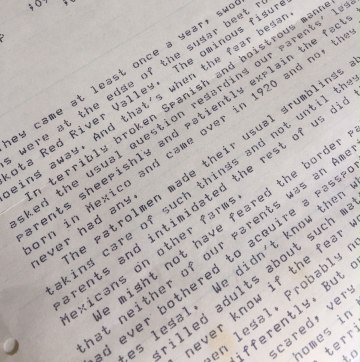
printoutThis is what I wrote (with a bit of minor editing):
THEY CAME IN at least once a year, swooping down, unnoticed until their green vans were at the edge of the sugar beet rows on the flat fields of the North Dakota Red River Valley. The ominous figures lumbered over to where we were hoeing away.

And that’s when the fear began.

In terribly broken Spanish and boisterous manner, la migracíon asked the usual questions regarding my parents’ legal status in the country. My parents sheepishly and patiently explained the facts: yes, they had been born in Mexico but they had been in this country since 1920. And no, they had no papers; they never needed any since they never went back to Mexico.

The border patrolman made their usual grumblings about the irresponsibility of not taking care of such things, and only after they had thoroughly humiliated my parents and intimidated the rest of us did they leave – to check on other Mexicans on other farms.

I might not have feared the border patrol so much had I not always worried that neither of our parents was an American citizen and, even worse, neither had ever bothered to acquire a passport to make their presence in the United States legal. I didn’t know then why they didn’t; children never grilled adults about such matters.

I will never know if the fear would have been different had my parents been legal. Probably not, given that the INS officers didn’t treat legal workers any differently. But one thing I do know is that I was scared, very scared. I feared my parents would be shipped back to Mexico, where they had not lived for more than 30 years.

The reality was that my parents were unlikely to have been deported after having spent so many years here.

And the reality was that government officials knew all too well that my parents and us were doing the work that nobody else wanted to do. If they had sent back to Mexico all people who did not have proper documentation, who would have hoed their sugar beets and picked their tomatoes, cucumbers, potatoes and other crops, at wretched wages while living in miserable housing?

But I didn’t know that. All I knew was that men with uniforms and guns were doing what men with guns and uniforms tend to do: instill fear in people. My fear was a justified fear. When you’re young and ignorant, fears have a tendency to grow to uncontrollable proportions. The prospect of our having to fend for ourselves forever in the windblown North Dakota plains because my parents had been deported was a real and menacing presence in my young mind.

THAT IS WHAT I feel when I think of the renewed efforts to clamp down undocumented immigrants.

I think of the children who will be forced to live in fear that some official in the green uniform will come take their parents away if they don’t have the magic card. I think of the parents who will be cowed by the uniform and authoritativeness of the officers and I wonder what that will do to their lives, and those of their children.

I fear for them. I understand all the arguments that nations have a right to enforce their borders, but that doesn’t ease the fear, the fear of the dreadful fear.


Posted in Uncategorized | Tagged , , , , , , , , , , , , | 3 Comments

Houston composer’s haunting music

I DON’T WRITE much about music on this blog. However, I’m going to make an exception because I want to share my enthusiasm for the music of a young composer, a native of Colombia who lives and works in Houston.

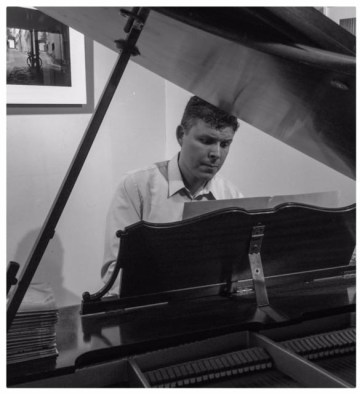
His name is Christian Restrepo. He came to Texas to do graduate work at Sam Houston State and the University of Houston, where he got his doctorate, but he has stayed here, working as a concert pianist, teacher – and as a composer. He also plays tango music with a group at various places in town.

christianr

Christian Restrepo


To describe him as energetic would be an understatement. Watching the way he bounces up enthusiastically to greet a person, the way he grasps an outstretched hand, and the way he expresses himself, orally and on the piano keyboard, brings to mind the Energizer Bunny – but with a charming personality.

I first heard Restrepo at the Alliance Française, where he was playing the piano for an art exhibit opening night reception. I learned that he recently recorded a CD of his music called “Música en Silencio.”

It’s a wonderful CD, full of beautiful, evocative sounds. Most of the 10 works are piano pieces but there is one piece for bass clarinet solo and another for piano and saxophone.

His Sonatina en Tres Movimentos starts with a movement that offers strong playful hints of Gershwin’s “American in Paris.” The last movement is a rhapsody based on Beethoven’s Für Elise. Sandwiched in between is a movement that reminds me of Chopin’s sonatas. All of them, however, quickly move to establish their independence and the result is a piece that works wonderfully as one.

Other tracks, Poema Nocturno for Alto Saxophone and Piano and Habanera Triste, in particularcome across as enchanting, mysterious pieces with heavy jazz and blues influences.

Taken as a whole, Restrepo’s CD is a beautiful production, filled with hauntingly beautiful sounds.

IF YOU’RE interested in getting this CD, you can email Restrepo directly at christianliszt@gmail.com.


Posted in Uncategorized | Tagged , , , , , , , , , | Leave a comment