Into Mexico

Flying into León. From there it will be about an hour’s ride (or 90 minutes, I forget which) by car to San Miguel de Allende.
Unlike San Miguel, León is flat country. It sits in the middle of a wide, wide valley. It reminds me very much of California’s Santa Clara Valley in that it is an agricultural region. Very smoggy. But it’s also a manufacturing hub, home to several auto companies. I wouldn’t be surprised if the car you’re driving was made here. Or parts of it were.
In SMA I’ll be staying at the home of friends, former Houston residents who now live in Colorado but spend as much time as they can in this beautiful city. (I was going to say colorful but I’ve decided to try to avoid using that word given that everything is colorful in this country).
I don’t know what I’ll do in San Miguel other than visit with my hosts and do whatever things they may have planned. But I will also roam around by myself, poking here and there in the hope of finding interesting things to take pictures of.
Tomorrow I will have coffee with a woman I’ve never met. She’s a pen-pal of my Swiss friend. She used to live in New Mexico but moved here not long ago. She sounds like an interesting person. She’s a former Peace Corps volunteer in Africa and is a quilter She blogs. About quilting, about her travels and other things.
On Monday I will go to Queretaro for a day and a half and from there I’ll take a bus to Mexico City for a four-day visit. I’ve never been to Queretaro (a weekend in a suburban hotel back in the 80s when I went there to cover a conference doesn’t really count). It’s a colonial city and has the usual number of attractions offered by this country’s colonial cities.
I haven’t been to Mexico City in many years. I think the last time I was there was also in the 80s, when I flew down from DC to interview the US ambassador to Mexico. I can’t remember his name now. A former actor. Friend of Reagan. He was a gracious interviewee but he complained about my report to my editors. Didn’t like how what he told me sounded like in print. He couldn’t claim that I made it up, though, because I had it all on tape.
I didn’t spend too many days in Mexico City on that trip but in 1984, I spent about a month there, covering a UN World Population Conference and then doing reporting for a special section on Mexico that The Houston Post decided to publish. It was something like 15 pages and every word (except for the headlines) was written by me.
My first trip to Mexico City was around 1980, Christmas time. I went down with a friend from graduate school and did all the touristy things, including the pyramids and the Basilica de Nuestra Señora de Guadalupe. I still have a picture of Rick, who is Jewish, joining the other pilgrims as they moved towards the church on their knees.
I am eager to see Mexico City again and to see how much it’s changed since I last saw it. I’ve read and heard of all the new museums and galleries, and I can’t wait to see them.
Flying into León and driving to SMA or Guanajuato always remind me of the Josè Alfredo Jiménez tune, “Camino de Guanajuato,” one of his most beautiful songs despite its gloomy opening lines (No vale nada la vida. La vida no vale nada. Comienza siempre llorando y así llorando se acaba.).
We are about to land. More later.

Posted in Uncategorized | 1 Comment

The absence of sanity

I HAD BRUNCH with an old friend today. He now lives in New York State, north of the city, but he comes down to Texas every now and then for work, and to visit with family and friends.

I first met Michael shortly after I started writing a column for The Houston Post. He didn’t like something I had written and wrote to tell me about it. (That was before the advent of email) He told me later that he didn’t expect me to respond, but that if I did, I would probably respond negatively. I surprised him instead by thanking him for writing and inviting him out for a meal or coffee to talk about the issue that had provoked his reaction.

We did meet and we had a great conversation and we continued to stay in touch, even after I’d moved to Washington and he’d married and moved first to Georgia and then to New York. When I was in New York two summers ago, we went to an Astros-Yankees game together at Yankee Stadium, and I visited with him and his wife the last time they were in Houston.

Michael is still a conservative and I’m still a liberal but we’ve learned to get along quite nicely, not by avoiding the issues on which we don’t agree, but by talking about them in a calm, dispassionate manner. It’s a good and valuable friendship.

ON THIS TRIP, Michael had a present for me: a copy of The Houston Post from January 17, 1991 (a few months after I had started writing my column). The headline on the front page is “War! Massive air raids slam Iraq targets.”

I knew immediately that in this issue was printed what I consider to be one of the best columns I wrote for The Post. (I didn’t get many compliments about it after it was published so I know my assessment of its worthiness wasn’t widely shared, but I still believe it was one of my best, particularly considering the circumstances surrounding its publication.)

When news of the U.S. attack on Iraq broke out late in the afternoon of January 16, I had already written my column for the next day and turned it in to my editors. But when I learned about the assault, I just knew that I couldn’t go with that original column. I don’t remember what it was about, but it had nothing to do with the latest developments, and. I knew I had to write about the new war.

And so I went to my editor and asked to have the column back, promising that I would have a new column in a short while. He agreed, reluctantly, and I sat down to write. Within 35 minutes I had finished, and it took me another 10 minutes to edit it, and I was done. I turned it in and, with only minor changes, it made it in the next day’s paper, under the headline, “Where has all the sanity gone?”

This is what it said:

SO NOW WE are at war. As I write this, it is too early to tell how this semi-declared war is going.

Are the good guys winning?

We’ve been told we should never doubt that.

Are some of our soldiers dying?

Are some of them already lying in pain and anguish in the desert or on some military hospital ship off the coast of Saudi Arabia?

Are innocent Iraqi men, women and children dying by the hundred as our planes and missiles deliver their lethal payloads?

We’ve been told to expect as much.

Are Iraqi missiles and planes loaded with poison gas or biological bombs making their way through the darkness to Jerusalem or Tel Aviv?

We’ve been warned that too is a possibility.

How long will it be before the flag-draped coffins start arriving at American air bases, from there to be transported to cities and towns across the country for military burials?

Not long, I’m sure.

How many? Who knows.

How many grieving widows, mothers and fathers, children, siblings and other loved ones will gather around those caskets to bid them farewell.

Hundreds, perhaps thousands, if some of the more dire predictions prove true.

How many times will we hear the expression, “he died for his country” uttered by pastors and other eulogists, and how many times will the grieving survivors be comforted by that?

YES, THIS IS war.

This is what we as a country, thorough our elected representatives, decided we wanted, even if we set aside our national charter, the Constitution, in doing so.

We, the people, gave one man, George Bush, the power and the authority to kill and maim people – as many as it takes – to bring another man, Saddam Hussein, to his knees.

And we gave George Bush the power and authority to subject our uniformed men and women to the same fates of death and destruction.

It doesn’t sound nice, but that is what war is: human beings resorting to killing and maiming each other because they failed – or refused – to use their reasoning faculties.

“War begins,” the headline on the first wire service story reads.

A more accurate headline would have been, “Sanity ends,” for war is surely not just an absence of peace, as we’ve been told – war is an absence of sanity.

There is little comfort to those who must suffer the consequences that one side was saner than the other, that one side was right and the other was wrong, that one leader was a madman while the other was a statesman.

There is no comfort in war.

“The liberation of Kuwait has begun,” were the first words from the White House.

No doubt there will be successful conclusion to this liberation, but what about the liberation of mankind from the horrors of war? When is that going to begin?

When is the United Nations going to set a deadline for our liberation from insanity?

IT IS A strange experience, being a witness to this tragic turn of historical events. I have never experienced this before, since Vietnam pretty much sneaked up on us.

I am scared, and I am angry.

As I look across the newsroom, the faces of my colleagues are somber, and even the feeble attempts at humor seem laced with dread.

This is all new to us, and some of us haven’t quite figured out how to react, as I’m certain most of you haven’t.

Yet it’s news and we must do our jobs by covering it. The adrenalin will flow and the pulses will quicken as we rush to meet this first deadline for bringing you the first installment of the news of this latest failure of mankind.

We’ll do the job, as you will do yours. But you and I will go home at night to our warm beds and our loved ones.

In the Middle East, even at this dawning hour of the war, there are some people – Americans, Iraqis and others – who will never go home.

Welcome to our war.

Posted in Uncategorized | Tagged , , , | 2 Comments

The day I came to understand what people meant when they talked about Ronald and Nancy Reagan’s “great love affair”

IN THE SPRING of 1980, not long after I had been named The Houston Post’s political writer, I got a call from the Ronald Reagan campaign. The former governor was going to make a swing through Houston and would be amenable to sit down with me for a few minutes if I wanted to interview him.

Reagan was seeking the Republican Party’s nomination to take on President Jimmy Carter. The interview would have to be at the lounge of a private aviation firm at Hobby Airport. Reagan was to fly in to Hobby and then get on a motorcade to Almeda Mall, south of Houston, where he was to do a walkthrough.

I was told that Reagan would have a few minutes for the interview before getting in his limo to head to the mall but when I got to the airport, I learned that Reagan’s flight was a bit late and that the interview might be a bit shorter than planned. Then I was told that there would be no time for a sit-down interview but that I was welcome to join the candidate and his wife in the limo and I could interview him during the short trip.

More than 35 years later, I do not remember a single question I asked Reagan, nor do I remember any of his responses. What a I do remember was that when we got to the mall’s parking lot and we exited the limo, I became part of the Reagan entourage as we were escorted into the mall where throngs of crazed fans were waiting to greet him and the future first lady.

OVER MY MANY years as a reporter, I had learned that the best way to cover an event is not to be part of that event, but rather to be apart from it, to get a better perspective. And so, as soon as we entered the mall, I tried to make my way away from the Reagans and their Secret Service guards and aides. I wanted to follow them closely, but at a distance, to be able to get a better view and sense of the crowd.

However, the enthusiastic crowd was too thick; it was like a wall that prevented me from escaping, and so I was forced make my way through the mall close to the candidate, his wife, a few campaign staffers, Secret Service agents and local police officers. Most of the time I was walking close to Mrs. Reagan.

It was pure bedlam as wave after wave of adoring Reagan fans rushed in to try to shake his hand, or to touch him or – failing that – settling for touching Mrs. Reagan. Some seemed content to touch the campaign aides, or even me.

Despite the large number of people, we slowly made our way through the mall. As we did, I took turns observing Ronald Reagan, his wife and the Secret Service agents. The look on the candidate’s face was shear joy. The agents’ faces showed pure business. On Mrs. Reagan’s face, I saw a smile that matched her husband’s but her eyes were apprehensive, matching those of the agents.

“We love you, Ronnie,” “Attaboy,” and “Give ‘em hell, Ronnie” were heard over and over again.

Mrs. Reagan, too, got some comments.

“Stand by him,” one woman yelled.

“I will, always,” she replied as she walked patiently alongside the candidate.

SOON AFTER WE started walking, I heard one of the local police officers say something to a Secret Service agent about “a local crazy” and point to a woman in the crowd, a few yards ahead. The agent nodded and turned to talk to another agent. Soon I saw another agent whisper into Mrs. Reagan’s ear as he too pointed toward the woman. Mrs. Reagan looked at the woman and nodded.

The woman was white and appeared to be in her 60s. She had a wide grin on her face but there was nothing unusual about her as far as I could tell. But for some reason, she was evidently on a list of potential threats to politicians such as Reagan.

What followed was an intriguing game of defense designed to keep the woman from getting anywhere near Mr. Reagan. Each time the woman came near the entourage, the police and Secret Service officers would form a solid wall between her and Reagan, much like a football defense team keeps opposing players from getting near their quarterback. The woman would fall back into the crowd but she would quickly circle around and eventually end up back in our path, only to be met by the same solid wall of officers.

Several times she protested, “I used to know him when he was 5 years old,” to anyone who would listen. Few would.

THIS HAPPENED AT least three times and on each attempt she was successfully repelled. Until, on about the fourth attempt, just when it appeared as if she had given up and gone away, there she was again. She had managed to sneak in close without being noticed by the officers, and the only person between her and Reagan was Nancy Reagan. As the woman lunged towards the candidates with an outstretched arm, one of the agents yelled, “Watch out, there she goes.”

Without a moment’s hesitation, Mrs. Reagan, who had been walking slightly ahead of her husband, moved quickly to block her. The woman’s hand had made it to within inches of Mrs. Reagan’s shoulder before the agents grabbed her and hustled her away.

“That’s enough for today,” he told her. She protested that all she wanted to do was to shake his hand.

Apparently, that was all she did want because there was no knife or gun in her hand. Had she been carrying a knife or other weapon, however, I am certain that Nancy Reagan would surely have been injured, if not killed.

That was the last I saw of that woman. Eventually, we made it through the mall and to the waiting motorcade to take us back to the airport. Nobody mentioned the incident with “the crazy” woman.

I told my editor about, though, and offered to write about it but he declined. He didn’t think it was important. I went ahead and wrote it up anyway and put it in my files. Less than a year later, on the day of Reagan’s attempted assassination outside a Washington DC hotel, I mentioned the story again, and this time it was printed the Sunday after the shooting, under the headline, “Secret Service’s best-kept secret is Nancy Reagan.”

I WAS NEVER a fan of either of the Reagans, but I came away from that incident convinced that there was nothing fake about the legendary “love affair” that was the Reagans’ marriage. I don’t know if Ronald Reagan would have stepped in front of a potential killer to save his wife’s life, but I know Mrs. Reagan would have – and did – on that one spring day in Texas in 1980.


Posted in Uncategorized | Tagged , , , , , , | Leave a comment

Finding what we’re looking for

I WENT TO the Houston Public Library today. It was a beautiful (if windy) day so I decided I’d ride my bike there. I figured I could always use the exercise and I wouldn’t have to worry about parking.

I wish I could say it was a thoroughly pleasant experience, but it was not.

To start with, the guy at the front desk who issued me my library card wasn’t particularly friendly. He tended to bark and mumble and I had to ask him to repeat himself several times, which didn’t please him.

The woman behind the reference desk on the third floor was about as welcoming as the guy at the front desk and she grumbled about the number of microfilm rolls I needed.

When I finally got the rolls of microfilm, I couldn’t figure out how to use the viewing machine and there was no staff around to ask for help.

Eventually I did get help, from a young man who was using machine nearby.

Once I got my viewer going, it didn’t take long for me to realize that I was looking for a needle in a haystack and that if I were to find the article I was looking for, it would take a lot longer than the few hours during which the library was open today.

So I did what I do best: I quit.

BEFORE LEAVING THE building, I decided to visit the men’s room. While standing at the urinal, I heard some truly horrific sounds coming from one of the stalls that made me want to get the hell out of there as quickly as I could. I went to the sink and washed my hands more thoroughly than I normally do. Had there been a shower there, I would have probably taken my clothes off and cleansed me entire body.

Then I turned to the paper towel dispenser to find that it had no towels. I dried my hands on my pants and left that room. Rather than leave the building, I decided to do my civic duty and inform the staff about the lack of towels. I finally found a worker and told her, “There are no paper towels in the men’s room.”

She looked at me coldly and said, “Yes, we know.”

“You know? That’s it? You know?”

“Yes,” she said smugly. “We know, and that’s why we have blow driers.”

I spun around and walked to the stairs. When I got the second floor I realized I didn’t have my backpack with me, so I hurried back up to the third floor and was greatly relieved to see my backpack on the floor, where I had left it. My camera and extra lens were still in there.

SO FINALLY, FINALLY, I make my way outside and head towards where I had locked my bike on one of the bike racks.

But I couldn’t find my bike. In the slot where I had locked by bright green bike was instead a dark gray bike. Having had five or six bikes stolen over the last couple of decades, I am by now very familiar with that stunned feeling, that realization that my bike is gone and I’ll never see it again.

I was about to start walking home when it hit me: I no longer have a green bike; it was stolen a couple of years ago. And I replaced it with a dark gray bike, exactly like the one that was locked to that rack!

THE JOY OF finding my never-lost bike was tempered with the awful realization that this is probably what my like is going to be like from now on. Forgetting backpacks. Forgetting what my belongings look like. Forgetting.

I probably would have sat down on the curb and started crying. But I didn’t. Instead I unlocked the bike, put on my helmet, turned on the various blinking lights and got on that dark gray bike to make my way home, fighting the strong headwinds all the way.

And the reason I didn’t give up was that less than an hour earlier, as I was still going through some of those microfilm rolls, I felt a tap on my shoulder. I turned around to see the smiling face of that young man who had helped me earlier. He had his backpack on and was obviously on his way out.

“I hope you find what you’re looking for,” he said, and then he walked away.

He could have simply left, and gone to wherever he needed to go, but instead he took a few seconds to tell me, “I hope you find what you’re looking for.”

ME TOO. I hope he finds what he’s looking for. I hope we all find what we’re looking for. Even if we never lost it in the first place.

Posted in Uncategorized | Tagged , , | Leave a comment

These are my babies, he said.

IT WAS A beautiful day yesterday and I opted for a bike ride instead of a visit to the gym. And instead of following my usual route along the Buffalo Bayou trail, I headed east, towards the Mexican part of town.

I ended up in the Second Ward, on Altic Street, where I came upon a cemetery, several acres of greenery in a neighborhood of modest homes. What intrigued me about this cemetery was the row of industrial buildings next to it; I thought that the juxtaposition of the cemetery against the warehouses might make for good photos.

So, finding the gate open, I rode my bike in and pedaled towards the back, careful to stay on the hard grassy area near the gravel lanes because I wanted to avoid riding over a jagged stone and getting a flat tire.

The reason I headed to the back portion of the cemetery was that in the back was where the color was. The front of the cemetery consisted of older plots with the kind of tombstones or headstones you’ll find in an average Anglo cemetery in this country. Staid, somber and colorless.

I learned later that Evergreen was established in 1894 for Anglo families but that in recent decades, it has become a predominantly Mexican cemetery, not surprising given that the area is mostly Mexican.

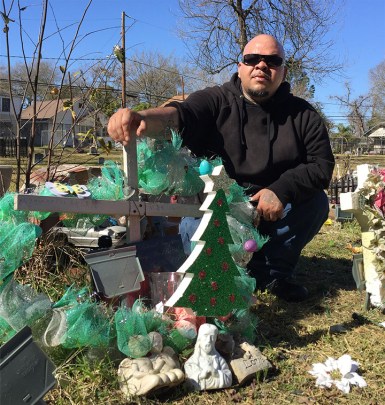
Before I entered the gate, I had seen a burly Mexican guy riding a bike along one of the roads on the perimeter of the cemetery. His head shaved, he had tattoos on his hands and forearms, he had a small goatee and a thin moustache, and he was wearing shades and a black hoodie.

As I got off my bike and proceeded to take my camera from my backpack, I worried a bit about the guy. I could no longer see him but I wondered what he was doing there, and in the back of my mind, I could hear the faint warning: don’t be stupid, that guy could be a thug and if he were to assault you here, there’d be nobody around to stop him – get your ass out of here.

But I suppressed that nasty voice; I wanted the photos, and so I stayed and started looking around for possible good shots. I quickly realized that the warehouses in the back didn’t really work as an interesting backdrop, but I found a couple of very intriguing gravesites and I spent some time shooting those.

SATISFIED, I GOT back on my bike and headed back towards the gate. Just as I exited the gate, however, I heard someone calling me. It was the guy on the bike.

Could I take his picture?

I hesitated for half a second before saying yes. Then he said, not here, but back there, in the back, with my babies, and he pointed to the far end of the cemetery then started riding in that direction, expecting me to follow him.

Yikes! Trepidation started setting in. What if he wanted me back there, where nobody could see, to beat me up, take my wallet, by camera and my bike? Who would come to my rescue?

But I had already said yes. To say no now, after first agreeing, would be cowardly, and ­– if the guy had no bad intentions – completely disrespectful.

So I followed. He was way ahead of me so I paid less attention to the jagged stones on the gravel road, and finally joined him at the edge of the cemetery, the area on the outskirts of the cemeteries that in traditional Mexican camposantos is reserved for angelitos – babies who die at birth or soon after, or are stillborn. The theory is that these young souls become angels and act as guardians to the rest of the bodies lying in that cemetery.

I got off my bike and followed him to one of the numerous tiny gravesites. I still had a bit of fear in my heart, but that was quickly dissipating.

The plot had a small grayish wooden cross, kept together with screws and wire. On one side of the horizontal beam was scrawled the name María de los Ángeles and on the other, María de Jesús.

There was also a small Styrofoam Christmas tree on the plot as well as several plaster statues – of Jesus, a couple of angels and something that looked like a frog. There were plastic Easter eggs, and the entire thing was framed by a green wreath made from plastic mesh.

These are my babies, he said.Servando-2-20160211

Your daughters?

No, no. My nieces. They passed away right after they were born. I try to visit them often, but I live far.
His name was Servando, and he explained that when he saw me taking pictures, he thought it might be a good idea to get a picture of himself with the gravesite of his babies.

I started to take out my camera.

No, no, he said as he reached into the pocket of his hoodie. With my phone.

He handed me his battered smart phone and knelt next to the cross on the gravesite to pose for the picture.

If I use his phone, I thought, I will leave here with no picture of him. After all this, I had to have a photo of this guy in this place. So I started to try to convince me to let me also shoot him with my IPhone, explaining that I could get a much better photo that I would be glad to share with him if he’d just give me his email address.

He finally agreed and I took the picture of him, posing proudly and lovingly with his left hand resting on the top of the wooden cross.

When we finished, I handed him my business card and asked him to send me an email so that I could send him a copy of the photo.

He said he would and, just as I was ready to get on my bike, he asked if I could take just one more picture.

Way on that side, he said, pointing to the opposite corner.

I agreed and got on my bike to follow him. Halfway there I realized that what I feared the most had indeed happened: my rear tire was flat. I got off and walked the rest of the way.

When we got to the other gravesite, of someone named Carillo, he explained that his uncle was buried there. I took the photo with his phone and this time I didn’t bother to use mine and, as we prepared to leave, he said, Adios Tío. Next time I’ll bring flowers.

Again, I said good-bye to him and encouraged him to send me his email address. I explained about my bike and asked if by any chance there was a bus stop around.

It turns out I was very close – about three blocks – from a station on the East Side rail line and I was able to get home without much difficulty.

ORDINARILY, I WOULD have been upset about my busted tire, but on this day, a flat tire seemed to be a small price to pay for such an adventure, and for the opportunity of getting to meet a man whose love for two nieces he’d barely gotten to know and for an uncle who was long gone was so great that he was willing to ride a bike a long distance to go pay them a visit – and who desperately wanted a visual recording of that visit.

Posted in Uncategorized | Tagged , , , , , | 1 Comment

Shiny red fruit

IT’S ABOUT THIS time each year that I am heartened to hear a different kind of bird call in the trees outside my home office window.

Most of the year I listen to the arrogant, even prideful calls of the mockingbirds, but every year, sometime in February, I begin to hear the high-pitched trilling and tweeting of the cedar waxwings who have come from who-knows-where to feast on the berries in the trees outside my window.

cedar waxwing

Cedar waxwing during a visit last February


Don’t get me wrong. I love mockingbirds and their calls. They are so distinct. I remember the times I used to walk around in Washington ­– where I found very little avian variety – and every once in a while being pleasantly surprised by a different bird call, and I would know in an instant that if I looked hard enough, I would find a beautiful mockingbird in a nearby tree.

(I just glanced outside the window to find a mockingbird on a nearby branch, daring any other bird to challenge his gods-given right to the tree.)

I DO LOVE mockingbirds, but I also love variety, and that is why I am so ready for the first tweeet-tzzzeeet of the cedar waxwings.

They’ll only be here for a few days, until they strip the tree of its shiny red fruit. They chatter among themselves, no doubt commenting on the quality of this year’s vintage. And then, just as suddenly, they are gone. Where they go, I don’t know, but I presume it’s up north – al norte – in search of more beautiful berries.

Up North. That’s what we used to say when we were kids, to describe what we did each summer.

We’re going Up North, we’d say.

We’ve been Up North.

AND THAT WAS all we really needed to say. In a town that was some 90 percent Mexican – and 90 percent of those Mexicans went to Washington, Idaho, Montana, North Dakota, Minnesota, Wisconsin, Iowa, Illinois, Indiana, Ohio, Michigan and other northern states in search of work – everybody understood what we meant.

Everybody understood that, like the birds, we had to go Up North. The shiny fruit beckoned.

Posted in Uncategorized | Leave a comment

Damn It, Black Lives Matter

THE BEYONCE VIDEO and Super Bowl appearance has brought the “Black Lives Matter” concept back into the headlines. And sadly, most Americans still don’t get it. They don’t get what it’s all about.

I’m embarrassed to admit that even though I have been, from the start, in total support of the Black Lives Matter movement, it was not until recently that I was able to fully understand it and to be able to explain it – to myself, at least.

What made it difficult for me was that, like most Americans, I viewed “Black lives matter” as a declarative statement. When you see it as such, it is easy to understand why the typical response of Bernie Sanders and others was, “Well, all lives matter.”

That’s a natural response for any human being who doesn’t understand that Black Lives Matter is not a declaration, it is a response – a response to an actual declaration.

And that declaration is that black lives really don’t matter.

While you will be hard pressed to find anybody to declare openly that black lives do not matter, the message that many African Americans get on a daily basis is that their lives really don’t matter. This is particularly true for poorer African Americans living in our nation’s most neglected areas.

That message is delivered with every cop’s unjustified whack of a nightstick on a black skull or shoulder.

That message is delivered with every uncalled-for paralyzing shock of a Taser.

That message is delivered with every needless handcuff around young black wrists.

And that message is delivered with every avoidable shedding of too much blood leading to yet another senseless death, and another black family’s having to deal with the loss – the terrifying and heartbreaking loss – of a loved one.

Every single unjustified violent end of a black person at the hands of law enforcement personnel repeats and amplifies that message: black lives do not matter.

And it is in answer to that message that we get the natural reaction: Black Lives Matter!

It is in that context that it begins to make sense.

Sometimes I think that a lot of the misunderstanding over this simple reaction would have been avoided if whoever coined the phrase would have added a simple, “Damn it” in front of “Black Lives Matter!”

When you say, “Damn it, black lives matter,” it becomes pretty obvious that you are reacting to something and not simply stating the obvious.

When you say, “Damn it, black lives matter,” you are making it clear that you are reacting to a very bad situation and you want society to understand why such systematic violence against black lives hurts so much, and why it has to end.

Posted in Uncategorized | Tagged , | 3 Comments

A dying woman, a stern grandmother, a blessed child – and a miracle? A true story about life’s possibilities


[When I decided to use the image of the Santo Niño de Nuestra Señora de Atocha on the front of this year’s Christmas cards, I felt a need to explain why that image was important to me. I started out to write two or three sentences that would be included in the cards but once I started writing, I realized that there was no simple or short way to fully explain the significance of the image, so I ended up with the paragraphs below, which have a few more details than what is on the cards. A note for those of you receiving my Christmas card: the date below, July 9, 1939, is the correct date.]


IN THE HOT
South Texas mid-summer days of 1939, eleven years after she was married, two years after the death of her second child and less than a year after having given birth to her sixth, my mother lay in her bed in the small house that her father-in-law had built for her and Domingo.

Atorche222

Santo Niño de Nuestra Señora de Atochao.


Martina López Palomo, who was 31, was in pain most of the time and her constant moans could be heard by anyone in or near the house. María Luisa, their oldest child, had just turned ten, yet even now – three quarters of a century later – she harbors searing memories of my mother’s agonizing cries.

The doctor had told my mother that her ovaries were infected and that she needed to have surgery to remove them. Without that surgery, she would die. That was his verdict. But for whatever reason, my mother resisted, and so her suffering continued.

More than likely, money played a role in her decision. Or rather, lack of it. This was at the tail end of the Great Depression and times were hard. Although my father had worked for the railroad, when he stopped working because of his hand injury, his income stopped. And so it was up to my grandparents and Tía Benita, my father’s oldest sister who lived at the other end of the block with her husband, Melecio Alfaro, to provide food for the family. Tío Mele was a businessman and so his family was relatively well off, compared to ours and compared to the other families in the neighborhood, and Tía Benita made certain that her brother’s family did not go hungry.

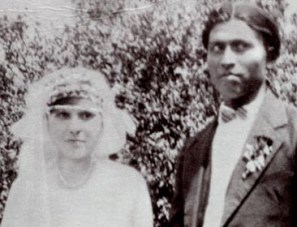
parentswedding-2

Martina López and Domingo Palomo on their wedding day, May 1928


But while there was enough family support to keep the family from starving, there was none for huge medical expenses, so my mother continued to suffer.

And her cries intensified.

alejandroandmanuela50th-1

Manuela Limón and Alejandro Palomo, on their 50th anniversary, November 1941.


There was little my father could do, for he was not around. He was 120 miles away, in a San Antonio hospital, recovering from a hand injury he had incurred while working for the railroad. Before he was taken to San Antonio – aboard a railroad handcar – he too had lain in bed for days, in agony, taking nothing but aspirin for his intense pain.

Until he was taken away, Luisa could hear him too. Crying, like a child.

My grandmother, Manuela Limón Palomo, would come in during the day to help take care of my mother, as would Tía Benita. There were times when my mother’s stepmother, María López, and others would come to help. But that was during the day. At night, it was up to Luisa to look after my mother and eight-month-old Mariana, and the other children, eight-year-old Delfina, five-year-old Alejandro and three-year-old Norberto.

My grandfather had fashioned a small hammock out of rope and canvas for Mariana.

“I would lie on the floor at night, near the hammock, and with my foot I would gently push it to rock it back and forth so that Mariana would fall asleep,” Luisa remembers. “But I couldn’t sleep: I kept hearing my mother’s lloridos.”

‘Buelita Manuela was a stern, no-nonsense kind of person.

Era de leyes,” is how Luisa describes her – she was stickler for rules, her rules.

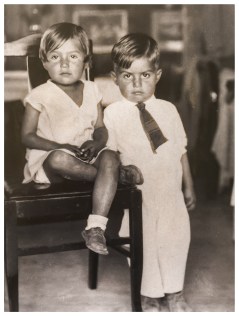
LuisaMeme.jpeg

María Luisa and Manuel


Among those rules was that it was up to Luisa to keep Mariana in clean diapers. That meant soaking the diapers in a washtub filled with boiling water. Luisa not only had to stoke the fire to keep it burning, she had to stir the washtub’s contents with a stick and then use that stick and to remove the soaking diapers. The fact that afternoon temperatures surpassed 100 degrees didn’t matter; the diapers had to be washed.

When Tía Benita would come upon Luisa doing that chore, she would become angry at ‘Buelita and insist that she, Benita, could wash the diapers. But the next day, before Tía could come over, the old woman had already made Luisa wash the diapers.

Era mala reata,” Luisa says about ‘Buelita. (I don’t know if there’s a translation for that. A cruel piece of old rope?)

From her bed, my mother could see what her mother-in-law, whom she called mamá, would put Luisa and the others through, but there was nothing she could do about it.

“If I die,” she told Luisa one day. “Mamá is going to eat the four of you alive.”

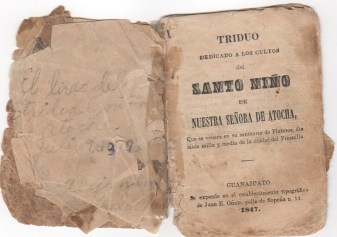
Manuelabook3On July 9, ‘Buelita, who lived next door, came to Luisa. In her wrinkled brown hands, she carried a small worn booklet. It is unclear how long she had owned it, but this we do know: She had carried that booklet, printed in Guanajuato in 1847, with her when the family had walked to Texas 19 years earlier from near San Luis Potosí. The booklet was a triduo (triduum), a three-day litany of prayers to the Santo Niño de Nuestra Señora de Atocha. (We know that date because Luisa wrote it, in pencil, on the front of the book.)

“Here,” she told Luisa. “Take this booklet. Use it to pray for your mother, so that she can live.”

Luisa did as her grandmother beseeched. She wanted my mother to live, and so she prayed. Every day. Religiously, asking the Santo Niño to return my mother to health.

And little by little, that’s what happened; my mother did begin to get better, and stronger, until one day she was able to leave her bed and once again resume her duties as wife and mother.

My mother was to live for more than 52 years after her illness, and she was to give birth to three additional children, including me, the youngest.

Luisahead4-1

Luisa, a few years later

When it became clear that my mother would live, Luisa made a promise to the Santo Niño that she would one day visit His shrine in Mexico. Many decades later, Luisa fulfilled her vow by making that pilgrimage to the shrine, which is near Fresnillo, Zacatecas, to offer her thanks.

WAS MY MOTHER’S recovery a miracle of the Santo Niño de Nuestra Señora de Atocha? Or was the doctor simply wrong in his initial prognosis? Or was my mother’s fear about what would happened to her four young children should she die enough to give her the strength to defeat whatever was wrong with her?

I don’t know. Over the years, I have learned to steer clear of certainty when it comes to matters of the soul, or of the universe and beyond. But I have also come to the conclusion that while nothing is certain, everything is possible. And so I’ll leave it at that.

During my most recent visit to her home in California, Luisa chose to make me be the keeper of this precious and delicate booklet. It is in dreadful shape, but I consider it and its tattered yellowed pages among my most-prized possessions.

At the front of the booklet appears the image shown on this card. There are many versions of this image, but I have searched extensively online and I have yet to find a version that matches this one exactly. After I made a copy of the image, I started to Photoshop it to remove the blemishes and other signs of wear and abuse, but I quickly decided that those signs were part of the essence of its beauty, and so they remain.

IN THIS SEASON of peace, promise, joy and new beginnings, I have elected to share this image – and this story – with you, in the hopes that they instill in you and your loved ones a deeper sense of family, love and devotion – and the possibility of a better, more peaceful, generous and miraculous world.


Posted in Uncategorized | Leave a comment

A fire, a small town

Crystal City, Texas | November 28, 2015

A STRONG COLD front blew in from the northwest last night, pushing away the suffocatingly humid warm air that had settled over the region for days, and I woke up this chilly rainy morning to news that the home of Antonio Rivera, a retired medical doctor, and his wife, Gloria, a retired college administrator, had burned down in the pre-dawn hours. It is – or was – just south of town, on their small farm.

Apparently a faulty heater started the fire and it spread so quickly that they didn’t even have time to retrieve their cars’ keys, ensuring that the vehicles met the same fate as their house.

There are no radio or TV stations with news operations here, but the news got around quickly. My sister first heard the news very early, when her son, a deputy sheriff, called to tell her about it. Soon after that the phone rang repeatedly with calls from others who had heard the news and claimed to have new details. A cousin whose son is a volunteer firefighter, a friend who used to be related by marriage to the doctor, and others.

As is the case in most small communities, when you talk about things happening to people, you’re not talking about strangers; you’re talking about friends or relatives. In this case, Tony and Gloria are not relatives (although one of his nephews was married to one my nieces for a while, and they had two beautiful children together), but even though we haven’t seen each other in some time, you could say that we are friends, for it’s impossible to grow up in a small down and not be friends with people with whom you grew up.

Tony’s older brother, Tomás, was my junior high softball coach and my junior college French teacher. The Rivera family lived a block away from us. Our address was 513 West Edwards, theirs was 513 West Val Verde so when we stood at our kitchen sink and looked south through the kitchen window, we could see the Riveras’ front door. That house still stands; ours was torn down in 1965 by Urban Renewal.

Gloria Amaya grew up on the other side of town so I didn’t know her that well. But I got to know her better in the summer of 1963 when our family ended up in a migrant camp near Endeavor, Wisconsin, where the Amaya family and several other Crystal City families were also working and living.

Six days a week, all of us, some 40 or 50 men, women and children, worked side by side, bent over or on our knees, crawling across vast verdant mint fields, pulling up weeds, tossing them into bushel baskets and emptying those baskets onto wagons to be carted off.

It was tedious work but it wasn’t backbreaking. Compared to other work, this was relatively easy. We were on the soft, spongy loam of dry ancient lakebeds. The work was not hurried at all and the slow pace encouraged conversations and jokes, so every day out on the fields was like a fiesta; the camaraderie was stimulating, addictive.

Gloria was the oldest in the Amaya family. Next to her was Joe. Although Joe and I were in the same class, we were never friends until we got to know each other at the Kempley Farms migrant camp near Endeavor. He and another boy, Gustavo Jiménez, who was a year behind us in school, and I became good friends and we continued that friendship when we came back to Texas to begin the school year.

Eventually the old gang drifted apart. I went off to college and Joe and Blanca, his wife, moved to Michigan. Tavo stayed here and became a successful businessman, but he died a number of years ago. Joe is also now retired and comes down to Crystal City during the winter to get away from the Michigan cold.

SO THERE IS a connection there. And that’s the thing about life in a small town: there always is a connection. That is why even though the Riveras, as retired successful professionals, are probably not hurting financially, the community is already coming together to rally behind them. A gofundme page has been set up and, in fewer than 24 hours, it has already raised close to $1,000.

That fund will grow, for no doubt everyone in this community is thinking, “That could have been me – that could have been my home.”

Losing a home – and everything in it – to a fire right after Thanksgiving just as winter makes its late arrival has got to be difficult for any family, no matter how strong or financially secure.

Everyone here understands this, and so the community comes together to help its own.

In the days ahead, the phone calls and coffee shop conversations about the Rivera fire will continue. So will the speculation and theories about the cause of the fire and what the family will do. And the community will continue to rally behind the Riveras.

That’s what happens in a small town. That’s what people do.


Posted in Uncategorized | 1 Comment

Looking back: Adventures and misadventures in Paris

14 November 15

This  morning I was doing a search for my favorite Paris photos to share on Facebook and came across this letter I wrote some 11 years ago to my friend Rogelio Cannady, who was then on Texas’ death row and has since been killed by the state. He loved reading of my travel adventures and so I made it a practice to describe the things I saw and did while on the road. 

01 September 04

HERE I AM, in the great city of Paris. It’s a bit after 5:30 p.m. and I am sitting at an outdoor restaurant, one of several thousand in this city, drinking a glass of red wine.

I also asked the waiter for a plate of various cheeses, but I guess he didn’t hear me, misunderstood me, or decided to ignore me. All three are possible, I’ve learned. All those French classes I took and I can’t even order a damn simple plate of cheese! That is how it has been all day: As soon as someone speaks to me in French, I get all nervous and I end up talking gibberish. When I ordered the wine, for instance, the waiter asked me if I wanted it “en verre,” which means by the glass, or if I wanted a carafe. The only thing I heard was sound, “ver,” which sounded very much like “vert,” the word for green (the French drop just about every consonant, unless it’s followed by an ‘e’. My first thought was, why is he asking me if I want green wine when I just asked for red wine? As happens almost every time, he saw my confused face and posed the question again, in English. By this time I was so rattled that I told him that yes, I wanted a glass, when the reality was that I wanted a carafe. Oh well, as they say here, c’est la vie. (At least I hope they do; they do in the movies!)

Here’s something funny: A few minutes ago, as I was standing at a street corner, looking at my map, trying to figure out exactly where I was, a young lady approached me and, in French, asked for directions to a nearby square, and I was able to tell her, also in French. She then turned around and told her companions, “Dice que está …”

”Ay,” I couldn’t resist telling her, “me ubieras dicho que hablas español!” We all got a good laugh out of it.

Oh wow! The waiter did understand me! He just walked up with my plate of cheese, and some bread. Oh man, this tastes great. Just what I needed. I love the bread in this country. How I wish you could be here to enjoy this with me.

I had already decided to return to the hotel, to rest a while. And go to the bathroom! But, because I was exhausted from all the walking I’ve done today, I decided to stop a while. I think that with this bit of food I won’t need to have supper; my stomach will be satisfied for the day.

I spent quite a bit of time this afternoon in what must be the old garment district in the old Jewish part of town, Le Marais. I wasn’t looking for any clothes, but I saw some real neat ties that I really liked, and when I inquired about their cost, I found out they only cost about $20 or $30, which is nothing compared to the ties in other stores.  I ended up buying four of them. Then I saw this beautiful leather jacket and I just had to look at it. Again, I was shocked by the price – $170. A coat like that in Washington would cost at least $300. I didn’t buy it, though. Because I saw another one I liked better, at about the same price. This one is wool, not leather. Now I have to figure out how to carry it home. I only brought a small suitcase with me, plus my backpack. If I keep buying things, I’m going to have to buy another bag, as I did the last time I came to Europe.

The weather has been spectacular. In the mid- to high-70s during the day, and in the 60s or 50s in the evening and early morning. Perfect walking weather, which is what I have been doing since I got here, except for the train/subway I took in from the airport because I didn’t want to pay for a taxi. The Metro system is vast and very easy to use. You can get just about anywhere on it. But, the way I see it, the more I ride the train, the less I see of this city – and the less time I have to stuff myself!

Last night I ate at a restaurant in the Latin Quarter, not far from my hotel, on a small street that was wall-to-wall outdoor restaurants. I sat outside and enjoyed watching the people walk by, and listened to a saxophone player who stood nearby and wailed away, with a number of jazz/blues pieces. Poor guy, when he finished playing, he came to where the patrons were eating to ask if we wanted to give him some money. I would have given him some, except that I thought he was asking if we wanted him to play some more tunes. By the time I realized what he wanted, it was too late; he was gone. The food (beef, with green beans and French fries) wasn’t that good. The meat was a bit tough and the potatoes lacked taste. Only the beans were good. And the bread, of course. Oh well. While I was waiting for my food, I noticed a sign on the wall that said Ernest Hemmingway had lived in the building for five years. The menu also had another literary claim. It seems that some French poet, whose name I had never heard of, lived there also. He ended up killing himself, apparently because he fell in love with another poet (also a male) and that was a no-no. At least that’s what I think I read.

Thursday, September 2

I AM IN LINE, waiting to climb to the dome of the Pantheon, which was originally a cathedral but is now a temple to French heroes. It’s a massive structure, although much simpler than the elaborately decorated cathedrals of Italy. It dominates the neighborhood in or near the Latin Quarter, not too far from the Luxembourg Gardens, one of several large formal gardens that provide a great place to rest and enjoy nature. Victor Hugo and other famous Frenchies are buried here. While waiting, I drew a quick sketch of part of one of the numerous statues. A bit simple, but I like it. I will try to make a copy of it and send it to you.

This morning I again started out somewhat late, for me. Normally, I am up and about by 6:30, but I guess my body has just been really tired, from all the walking, and even though I wake up early (7 or 7:30), I just lie there and before I know it, it’s already 8 or 8:30. No big deal, though: I am determined that this will be a relaxing trip, and if sleeping late helps me accomplish that, so much the better.

My hotel is a small tourist hotel. I wouldn’t call it quaint, or cozy, but it is comfortable and my 2nd-floor room is of a decent size. Certainly a lot larger than the one I got in Florence, which was so small that if I left any of my stuff on the floor, I could not walk to the bathroom. It’s air-conditioned, so I don’t have to listen to the traffic outside, although traffic noise is not that bad. For 10 Euros, I can get a decent breakfast downstairs, and for 5 Euros, I can log on to the Internet for half an hour. It would be more than enough to check the news and write a few emails if it weren’t for the damn French keyboard, which has certain letters – the y, the z and the m, for instance, in different locations altogether. The other guests are mainly Brits, and a few Americans and what appear to be Spaniards or South Americans.

I am now at a small park, Jardin the Teuleries, a huge park that connects the Arc de Triomphe with the Louvre, the large museum that houses the Mona Lisa and other masterpieces. I will visit neither. The arch because I was there the last time I was here, in 1988, and the museum, because I really do not like museums that much. Large ones, at least. And I have seen enough pictures of the Mona Lisa and the other masterpieces to know what they look like. I don’t think that when I die I will be ruing the fact that I never saw the Mona Lisa.

It is late afternoon and the weakening sun infuses the entire park with a nice, subdued hue. I am sitting on a metal green chair, one of many in this area of the park, surrounded by others, alone, in pairs or in groups, sitting and enjoying the sun amid the various pools and fountains.

The park resembles the Mall in Washington, but it is a lot more serene. It has a lot more trees, and it has these chairs, which is something you won’t find on the mall. It also has a lot of statues, mainly of mythological figures, but also some by some famous artists, such as Rodin and Maillol.

This is where I ate my lunch, cheese and bread and fruit that I snuck into my backpack at breakfast this morning. Delicious. I hadn’t eaten anything since this morning, when I bought something that looked like a Mexican empanada, and another pastry that looked like a campechana, at a patisserie, one of thousands of pastry shops all over the city that offer everything from pastries to sandwiches (yesterday, for lunch I bought a croq monsieur (I’m not too sure of the spelling), which is a hot ham and cheese sandwich; I was in heaven.)

I don’t know if I’ll eat anything this evening. I am not hungry, but maybe the walk back to the hotel will give me an appetite and if that happens, I’ll do another cheese-and-wine thing.

The Pantheon was very impressive, when we climbed to the deck that surrounds the dome. From there you can see the entire city, from the Eiffel Tower to Notre Dame and other famous sites. It’s a good place from which to see how different this city is from most American cities. There are skyscrapers, but they are away from the city’s center. I took lots of pictures, but the sun was very bright and there was a thick haze, so I am not sure how good they will be.

From the Pantheon I walked to the cathedral of St. Germain de Pres, one of the city’s most prominent Romanesque style churches, constructed in the 11th century. The bell tower is the city’s oldest. The heart of Rene Descartes is buried here. Don’t ask why just he heart because I have no idea. Neither do I know where the rest of his body is.

From there I walked along a street lined with some very expensive stores. No $30 ties here! My destination was a small museum, the Musee Maillol, dedicated to the work of Aristide Maillol. His work consists primarily of large marble sculptures of female nudes, most of them based on a single model, Dina Vierny. There are also some of the sketches he did of his models. This is the kind of museum I like: small and intimate, and I can get in an out in a few minutes. And – perhaps more important — it has a great bathroom!

And that’s what I have done today. To get here from the museum, I had to cross the Seine, which is always a nice experience. I love watching the boats and barges float by. I’ve been sitting here for about an hour, and I could stay here another couple of hours. It is so comfortable. Since I have been sitting here, it has become cloudy and it appears as if it might rain. According to the paper, it’s not supposed to rain until tomorrow. If it does rain, I hope it’s over quick. I hate walking around in the rain.

 

Posted in Uncategorized | Leave a comment