A fire, a small town

Crystal City, Texas | November 28, 2015

A STRONG COLD front blew in from the northwest last night, pushing away the suffocatingly humid warm air that had settled over the region for days, and I woke up this chilly rainy morning to news that the home of Antonio Rivera, a retired medical doctor, and his wife, Gloria, a retired college administrator, had burned down in the pre-dawn hours. It is – or was – just south of town, on their small farm.

Apparently a faulty heater started the fire and it spread so quickly that they didn’t even have time to retrieve their cars’ keys, ensuring that the vehicles met the same fate as their house.

There are no radio or TV stations with news operations here, but the news got around quickly. My sister first heard the news very early, when her son, a deputy sheriff, called to tell her about it. Soon after that the phone rang repeatedly with calls from others who had heard the news and claimed to have new details. A cousin whose son is a volunteer firefighter, a friend who used to be related by marriage to the doctor, and others.

As is the case in most small communities, when you talk about things happening to people, you’re not talking about strangers; you’re talking about friends or relatives. In this case, Tony and Gloria are not relatives (although one of his nephews was married to one my nieces for a while, and they had two beautiful children together), but even though we haven’t seen each other in some time, you could say that we are friends, for it’s impossible to grow up in a small down and not be friends with people with whom you grew up.

Tony’s older brother, Tomás, was my junior high softball coach and my junior college French teacher. The Rivera family lived a block away from us. Our address was 513 West Edwards, theirs was 513 West Val Verde so when we stood at our kitchen sink and looked south through the kitchen window, we could see the Riveras’ front door. That house still stands; ours was torn down in 1965 by Urban Renewal.

Gloria Amaya grew up on the other side of town so I didn’t know her that well. But I got to know her better in the summer of 1963 when our family ended up in a migrant camp near Endeavor, Wisconsin, where the Amaya family and several other Crystal City families were also working and living.

Six days a week, all of us, some 40 or 50 men, women and children, worked side by side, bent over or on our knees, crawling across vast verdant mint fields, pulling up weeds, tossing them into bushel baskets and emptying those baskets onto wagons to be carted off.

It was tedious work but it wasn’t backbreaking. Compared to other work, this was relatively easy. We were on the soft, spongy loam of dry ancient lakebeds. The work was not hurried at all and the slow pace encouraged conversations and jokes, so every day out on the fields was like a fiesta; the camaraderie was stimulating, addictive.

Gloria was the oldest in the Amaya family. Next to her was Joe. Although Joe and I were in the same class, we were never friends until we got to know each other at the Kempley Farms migrant camp near Endeavor. He and another boy, Gustavo Jiménez, who was a year behind us in school, and I became good friends and we continued that friendship when we came back to Texas to begin the school year.

Eventually the old gang drifted apart. I went off to college and Joe and Blanca, his wife, moved to Michigan. Tavo stayed here and became a successful businessman, but he died a number of years ago. Joe is also now retired and comes down to Crystal City during the winter to get away from the Michigan cold.

SO THERE IS a connection there. And that’s the thing about life in a small town: there always is a connection. That is why even though the Riveras, as retired successful professionals, are probably not hurting financially, the community is already coming together to rally behind them. A gofundme page has been set up and, in fewer than 24 hours, it has already raised close to $1,000.

That fund will grow, for no doubt everyone in this community is thinking, “That could have been me – that could have been my home.”

Losing a home – and everything in it – to a fire right after Thanksgiving just as winter makes its late arrival has got to be difficult for any family, no matter how strong or financially secure.

Everyone here understands this, and so the community comes together to help its own.

In the days ahead, the phone calls and coffee shop conversations about the Rivera fire will continue. So will the speculation and theories about the cause of the fire and what the family will do. And the community will continue to rally behind the Riveras.

That’s what happens in a small town. That’s what people do.


Posted in Uncategorized | 1 Comment

Looking back: Adventures and misadventures in Paris

14 November 15

This  morning I was doing a search for my favorite Paris photos to share on Facebook and came across this letter I wrote some 11 years ago to my friend Rogelio Cannady, who was then on Texas’ death row and has since been killed by the state. He loved reading of my travel adventures and so I made it a practice to describe the things I saw and did while on the road. 

01 September 04

HERE I AM, in the great city of Paris. It’s a bit after 5:30 p.m. and I am sitting at an outdoor restaurant, one of several thousand in this city, drinking a glass of red wine.

I also asked the waiter for a plate of various cheeses, but I guess he didn’t hear me, misunderstood me, or decided to ignore me. All three are possible, I’ve learned. All those French classes I took and I can’t even order a damn simple plate of cheese! That is how it has been all day: As soon as someone speaks to me in French, I get all nervous and I end up talking gibberish. When I ordered the wine, for instance, the waiter asked me if I wanted it “en verre,” which means by the glass, or if I wanted a carafe. The only thing I heard was sound, “ver,” which sounded very much like “vert,” the word for green (the French drop just about every consonant, unless it’s followed by an ‘e’. My first thought was, why is he asking me if I want green wine when I just asked for red wine? As happens almost every time, he saw my confused face and posed the question again, in English. By this time I was so rattled that I told him that yes, I wanted a glass, when the reality was that I wanted a carafe. Oh well, as they say here, c’est la vie. (At least I hope they do; they do in the movies!)

Here’s something funny: A few minutes ago, as I was standing at a street corner, looking at my map, trying to figure out exactly where I was, a young lady approached me and, in French, asked for directions to a nearby square, and I was able to tell her, also in French. She then turned around and told her companions, “Dice que está …”

”Ay,” I couldn’t resist telling her, “me ubieras dicho que hablas español!” We all got a good laugh out of it.

Oh wow! The waiter did understand me! He just walked up with my plate of cheese, and some bread. Oh man, this tastes great. Just what I needed. I love the bread in this country. How I wish you could be here to enjoy this with me.

I had already decided to return to the hotel, to rest a while. And go to the bathroom! But, because I was exhausted from all the walking I’ve done today, I decided to stop a while. I think that with this bit of food I won’t need to have supper; my stomach will be satisfied for the day.

I spent quite a bit of time this afternoon in what must be the old garment district in the old Jewish part of town, Le Marais. I wasn’t looking for any clothes, but I saw some real neat ties that I really liked, and when I inquired about their cost, I found out they only cost about $20 or $30, which is nothing compared to the ties in other stores.  I ended up buying four of them. Then I saw this beautiful leather jacket and I just had to look at it. Again, I was shocked by the price – $170. A coat like that in Washington would cost at least $300. I didn’t buy it, though. Because I saw another one I liked better, at about the same price. This one is wool, not leather. Now I have to figure out how to carry it home. I only brought a small suitcase with me, plus my backpack. If I keep buying things, I’m going to have to buy another bag, as I did the last time I came to Europe.

The weather has been spectacular. In the mid- to high-70s during the day, and in the 60s or 50s in the evening and early morning. Perfect walking weather, which is what I have been doing since I got here, except for the train/subway I took in from the airport because I didn’t want to pay for a taxi. The Metro system is vast and very easy to use. You can get just about anywhere on it. But, the way I see it, the more I ride the train, the less I see of this city – and the less time I have to stuff myself!

Last night I ate at a restaurant in the Latin Quarter, not far from my hotel, on a small street that was wall-to-wall outdoor restaurants. I sat outside and enjoyed watching the people walk by, and listened to a saxophone player who stood nearby and wailed away, with a number of jazz/blues pieces. Poor guy, when he finished playing, he came to where the patrons were eating to ask if we wanted to give him some money. I would have given him some, except that I thought he was asking if we wanted him to play some more tunes. By the time I realized what he wanted, it was too late; he was gone. The food (beef, with green beans and French fries) wasn’t that good. The meat was a bit tough and the potatoes lacked taste. Only the beans were good. And the bread, of course. Oh well. While I was waiting for my food, I noticed a sign on the wall that said Ernest Hemmingway had lived in the building for five years. The menu also had another literary claim. It seems that some French poet, whose name I had never heard of, lived there also. He ended up killing himself, apparently because he fell in love with another poet (also a male) and that was a no-no. At least that’s what I think I read.

Thursday, September 2

I AM IN LINE, waiting to climb to the dome of the Pantheon, which was originally a cathedral but is now a temple to French heroes. It’s a massive structure, although much simpler than the elaborately decorated cathedrals of Italy. It dominates the neighborhood in or near the Latin Quarter, not too far from the Luxembourg Gardens, one of several large formal gardens that provide a great place to rest and enjoy nature. Victor Hugo and other famous Frenchies are buried here. While waiting, I drew a quick sketch of part of one of the numerous statues. A bit simple, but I like it. I will try to make a copy of it and send it to you.

This morning I again started out somewhat late, for me. Normally, I am up and about by 6:30, but I guess my body has just been really tired, from all the walking, and even though I wake up early (7 or 7:30), I just lie there and before I know it, it’s already 8 or 8:30. No big deal, though: I am determined that this will be a relaxing trip, and if sleeping late helps me accomplish that, so much the better.

My hotel is a small tourist hotel. I wouldn’t call it quaint, or cozy, but it is comfortable and my 2nd-floor room is of a decent size. Certainly a lot larger than the one I got in Florence, which was so small that if I left any of my stuff on the floor, I could not walk to the bathroom. It’s air-conditioned, so I don’t have to listen to the traffic outside, although traffic noise is not that bad. For 10 Euros, I can get a decent breakfast downstairs, and for 5 Euros, I can log on to the Internet for half an hour. It would be more than enough to check the news and write a few emails if it weren’t for the damn French keyboard, which has certain letters – the y, the z and the m, for instance, in different locations altogether. The other guests are mainly Brits, and a few Americans and what appear to be Spaniards or South Americans.

I am now at a small park, Jardin the Teuleries, a huge park that connects the Arc de Triomphe with the Louvre, the large museum that houses the Mona Lisa and other masterpieces. I will visit neither. The arch because I was there the last time I was here, in 1988, and the museum, because I really do not like museums that much. Large ones, at least. And I have seen enough pictures of the Mona Lisa and the other masterpieces to know what they look like. I don’t think that when I die I will be ruing the fact that I never saw the Mona Lisa.

It is late afternoon and the weakening sun infuses the entire park with a nice, subdued hue. I am sitting on a metal green chair, one of many in this area of the park, surrounded by others, alone, in pairs or in groups, sitting and enjoying the sun amid the various pools and fountains.

The park resembles the Mall in Washington, but it is a lot more serene. It has a lot more trees, and it has these chairs, which is something you won’t find on the mall. It also has a lot of statues, mainly of mythological figures, but also some by some famous artists, such as Rodin and Maillol.

This is where I ate my lunch, cheese and bread and fruit that I snuck into my backpack at breakfast this morning. Delicious. I hadn’t eaten anything since this morning, when I bought something that looked like a Mexican empanada, and another pastry that looked like a campechana, at a patisserie, one of thousands of pastry shops all over the city that offer everything from pastries to sandwiches (yesterday, for lunch I bought a croq monsieur (I’m not too sure of the spelling), which is a hot ham and cheese sandwich; I was in heaven.)

I don’t know if I’ll eat anything this evening. I am not hungry, but maybe the walk back to the hotel will give me an appetite and if that happens, I’ll do another cheese-and-wine thing.

The Pantheon was very impressive, when we climbed to the deck that surrounds the dome. From there you can see the entire city, from the Eiffel Tower to Notre Dame and other famous sites. It’s a good place from which to see how different this city is from most American cities. There are skyscrapers, but they are away from the city’s center. I took lots of pictures, but the sun was very bright and there was a thick haze, so I am not sure how good they will be.

From the Pantheon I walked to the cathedral of St. Germain de Pres, one of the city’s most prominent Romanesque style churches, constructed in the 11th century. The bell tower is the city’s oldest. The heart of Rene Descartes is buried here. Don’t ask why just he heart because I have no idea. Neither do I know where the rest of his body is.

From there I walked along a street lined with some very expensive stores. No $30 ties here! My destination was a small museum, the Musee Maillol, dedicated to the work of Aristide Maillol. His work consists primarily of large marble sculptures of female nudes, most of them based on a single model, Dina Vierny. There are also some of the sketches he did of his models. This is the kind of museum I like: small and intimate, and I can get in an out in a few minutes. And – perhaps more important — it has a great bathroom!

And that’s what I have done today. To get here from the museum, I had to cross the Seine, which is always a nice experience. I love watching the boats and barges float by. I’ve been sitting here for about an hour, and I could stay here another couple of hours. It is so comfortable. Since I have been sitting here, it has become cloudy and it appears as if it might rain. According to the paper, it’s not supposed to rain until tomorrow. If it does rain, I hope it’s over quick. I hate walking around in the rain.


Posted in Uncategorized | Leave a comment

Statistics? We don’t need no stinking statistics! (My love affair with baseball)

YESTERDAY, I WATCHED the Astros from what is called the “Inspirity Club” of Minute Maid Park. Inspirity is a local bank, I think. Why any business would choose such an insipidly awful name is beyond me, but I do know there was nothing wishy-washy about the price for a single ticket: $175.

I know that, not because I shelled out that amount for the privilege of sitting in those seats with free food and a wide array of (not free) alcoholic beveragepanoramas and even a waiter to take care of your every need, but because that is the amount printed on the ticket. I got the ticket from my friend Mary, who knows the owner of those season tickets.
The Astros won, and that was obviously the highlight of the day. But there were other high points, among them the fact that when I got to the club, Mitch McConnell smiled warmly, welcomed me and opened the door for me. And Ol’ Mitch was there again to open the door for me at the end of the game. And again, he was smiling, hiding any concern he might have had about his future given what had just happened to John Boehner.

I will be at Minute Maid again this afternoon, though in much less sumptuous surroundings, for the last home game of the season. Win or lose, I will be a very happy man when the last out is called, for this has been an amazingly beautiful spring and summer of Astros baseball for me. I have attended more home games during this season than in any previous season, and I have watched on TV most of the games I could not attend. The Astros have given me much frustration, anger and sadness. But what I will remember most about the 2015 season will be the thrills and the joy and sheer elation that I felt as I witnessed some astonishing plays and hits.

I LOVE BASEBALL. I like football and have been known to enjoy basketball and futbol and other sports, but baseball to me is king. This is not to say that baseball is better than the other sports. I’ve been in way too many arguments with friends over which sport is superior, and I can tell you that every one of those arguments was stupid and pointless. There may be a scientific way to determine whether one game is better than all the others, but it really wouldn’t matter.

What matters is which of the sports tugs at the most heartstrings within us. And that most often has to do with which sport was most present and most emotionally satisfying early on in our lives, when our personalities were being formed.

For me that sport was baseball.

IT WAS BASEBALL – or rather, softball – that we, my cousins and neighbors and I, played on unpaved street of my South Texas hometown and in the dusty school playgrounds. It was baseball games featuring local teams against teams from neighboring towns (on both sides of the border) that my father would sometimes take us to watch at rundown city ballparks on Sunday afternoon. I remember little about the action on the field, but I have vivid memories of the drunk spectators who taunted and humiliated the players and the umpires.

It was pickup baseball games between teams from different migrant camps that we’d sometimes go watch in Minto or other small North Dakota towns on Sundays, the only day of the week when we weren’t out on the sugar beet fields.

It was the baseball World Series that we listened to on Tío Adrián’s car radio on cold autumn days, during lunch breaks around a wood fire at the edge of a North Dakota potato field. More often than not it was the Yankees playing – and beating – the Brooklyn Dodgers. I quickly became a Dodgers fan because my uncle and his children were huge Yankees fans. That was the beginning of my long love affair with underdogs.

It was to watch Sunday afternoon baseball on TV that Ernie Kwiatkowski, the Wisconsin cucumber grower on whose farm we lived a few summers, invited me to join him, and that is how I became a Milwaukee Braves fan.

It was high school baseball games featuring the Crystal City Javelins against teams from surrounding towns that my father would occasionally take us to on warm spring nights to watch players such as my cousin Mike and Tomás Rivera (who would later gain fame as a trendsetter in the Chicano literature world).

My father would park the car along the third-base line and allowed us to sit on the car’s hood or fenders, or on the grass, while he and my mother sat on the front seat. Hits and good defensive plays would generate not applause, but sustained honking from our car and other vehicles.

WHEN I GOT to junior high school, Crystal City started hosting an annual high school baseball tournament (Popeye Tournament, of course). If you bought tickets for all the games, you would be allowed to skip classes to attend the games. I always bought the tickets. Not because I wanted to skip classes (I happened to like school) but because I didn’t want to miss a single game. And I attended every home game that I could.

Most of those were night games that were held in the district’s sports complex at the other end of town from where I lived. I walked to every game, and I walked home after every game. The first half of the trip was OK because it was through the Anglo part of town and that meant paved streets, sidewalks and streetlights. Once I crossed the railroad tracks and entered our part of town, there was no pavement, there was no concrete and there were no lights. All that awaited me were darkness, rutted dirt streets, unwelcoming snarling unleashed dogs – and the possibility of a ghost or two to scare the living crap out of me. I never saw a ghost, but two of my sisters had seen bultos, and that was all the evidence I needed to know ghosts existed.

I did a lot of praying during those long walks down West Edwards Street. Some were anti-ghost prayers, others were anti-canine pleas. (My mother had taught us a doggie prayer when our grandfather started sending us to a neighbor’s house to pick up his daily Spanish-language from San Antonio. The neighbor had a mean dog and so we dutifully chanted: de tí. The devil is within you, God is in me; may the blood of Christ deliver me from you.) The prayers did the trick when it came to the dogs. Or maybe it was the rocks and sticks I always made sure I carried with me when I walked down that dark street.El diablo en tí, Dios en mí; la sangre de Cristo me libre de ti. The devil is within you, God is in me; may the blood of Christ deliver me from you.) The prayers did the trick when it came to the dogs. Or maybe it was the rocks and sticks I always made sure I carried with me when I walked down that dark street.

Those high school games were fun, lots of fun. I knew all the players because most were classmates of my older sisters. I didn’t know their batting averages or other statistics but I knew who was likely to hit and who was likely to strike out. I did a lot of pleading with them to do well and, when things got tough, with God set aside all the worlds’ problems to take a side, our side.

In those days Crystal City rarely had decent football teams, and its basketball teams were worse. But baseball? In baseball Crystal City often ruled. If it didn’t win district, it came close, and when the team went on to win bi-district and even regional (there weren’t any state playoff), the whole town went wild. Out-of-town games would be broadcast on KBEN, the local station, and the entire town paused to listen, and when the team arrived home, its bus would unload the players at the small park in front of city hall where the statue of Popeye used to stand, for a loud celebratory rally, one of the rare times when the town’s browns and whites (and its handful of blacks) would get together to celebrate anything.

“¡Ooooooorrra los Javalines!”Maxima Flores, wife of Jonas, a regular umpire at the games would yell when given the microphone. “¡Oooooooorrrrrra!”

We found that hilarious but we went along, and for days afterwards, we’d greet each other in the school hallways with, “!Oooooooorrra!”

I NEVER PLAYED baseball in school. I was a decent hitter but I never learned how to field a ball and I would panic every time a ball was hit my way. But my failure to master the game never dampened my love for watching the game.

When I went away to college, though, baseball and I parted ways for a long time. My junior college and Texas State (then Southwest Texas State) both had baseball teams but I was too busy attending classes and doing other things I enjoyed.

The first professional game I saw was at the Astrodome in the late 1960s, when I was working as a counselor for the summer Upward Bound program in San Marcos. One of the field trips we took the kids on was to a game between the Astros and the Padres. I don’t remember much about the game, probably because I spent most of the game staring in awe at the giant structure and its domed roof.

I DIDN’T BECOME an Astros fan until 1980, after I’d started working for The Houston Post and I became part of a group of city desk reporters who managed to get free tickets to the games. It was the years of Niekro, Ashby, Cruz, Cedeño, Puhl, J.R., Cabell and other great ones clad in silly orange outfits.

We went to a lot of games, our group did, and we drank a lot of beer. Too much. So much that we’d often roam out into the parking lots after the game, wander around and plead with strangers, “Have you seen our car?”

I have remained an Astros fan since then. When I was in Washington in the late 1980s, I would often drive to Philadelphia and Pittsburg at least once each summer to see the Astros play there. And I was again in DC when the Astros finally made it to the World Series. What I remember about that is walking the streets of the city after the final game, numb and emotionally drained, thinking that all hope was lost. Not just for the Astros or baseball, but for humanity.

AND NOW, HERE I am, nearing the end of another Astros season. Unless some miracle happens, it will go down as another disappointing season. Statistically. Only statistically. And that’s important, because statistics don’t measure joy and excitement. They don’t measure pleasure. They don’t measure thrills. And that, my friends, is what the Astros have given me all these past six months.

Posted in Uncategorized | Tagged , , | Leave a comment

Our morally indefensible minimum wage

[I came across this column I wrote for The Houston Post in February 1995. I post it here not because I think it’s that great, but rather because I was struck how little has changed over the last 20 years when it comes to this issue.]

SIXTY DOLLARS. Somehow, that was always the magic number.

If my mother worked enough hours to ensure that her weekly take-home pay from the Del Monte cannery would be at least $60 – which meant that she’d worked six 10-hour days at the $1.25 minimum wage – we’d issue a collective sigh of relief.

Sixty dollars meant that when we went to Tío Juan’s small grocery store, we’d be able to pay cash for the week’s supply of food and other necessities; the tab wouldn’t be entered in the credit ledger, to be repaid upon our return in October for our yearly trek to the sugar beet fields of North Dakota.

Sixty dollars meant we could pay the gas, water and electric bill. It meant that if one of us needed new shoes, we’d be able to go to JCPenney’s to buy them.

It meant that in my mother had taken out a loan from the local bank or credit union so that my sister could go to college one more semester, she’d be able to make the monthly installments on the note.

Sixty dollars meant we could make another payment to Dr. Poindexter, who owned the hospital and the pharmacy and allowed us to pay on credit.

In short, $60 meant peace of mind, if only for that week. The next, my mother’s check might be $50, or $40, or less – or there might not be a check at all.

One bad freeze would kill the spinach crop and that would mean the end of the weekly paychecks for an entire season. When that happened we’d have to survive on the $20 or $30 in unemployment benefits (if she had worked enough to qualify for benefits) and what little we could earn on weekends out in the field working at 75 cents an hour (the minimum wage excluded farm work).

ONCE, ONE OF my sisters talked my mother into taking a maid’s job because it would provide a steady paycheck. It did – $30 a week. When she returned to the cannery, she had lost her seniority and that meant less work. She never gave up, though. Every day, she’d hitch a ride to the cannery just in case somebody had failed to show up. If she didn’t get hired, which was usually the case, she’d do the same thing for the evening shift.

In case you think of this as a woe-is-me column, it isn’t. Those were relatively good time for us (although I can’t speak for my mother). We owned our house so we didn’t have to worry about rent. Gasoline often sold for a quarter a gallon. A candy bar was a nickel. A movie ticket 40 cents, a loaf of bread a quarter and milk 30 cents a quart.

It wasn’t paradise, but neither was it the oppressive misery of Appalachia or big-city slums. We never lost hope; we all believe that eventually, through education and/or hard work, we would escape that kind of life, and we did

No, this column is about the minimum wage debate. In the three decades since my mother was struggling to support us on $1. 25 an hour, the minimum wage has increased by 240 percent.

If the price of bread increased at that same amount, a loaf would cost you 69 cents today. So would a gallon of gas. A candy bar and a bag of Fritos would be 12 cents each. A movie ticket 96 cents, and popcorn would be a quarter.

THE POINT IS that there is no way anybody can justify opposing an increase in the minimum wage so that poor people can have close to the same buying power they used to have.

The usual argument against increasing the minimum wage is that we all suffer as a result of increased prices for consumer goods and services.

Why? Nowhere is it written that paying people a just, living wage means raising prices. Most companies can pay higher wages without raising prices if they’d be willing to sacrifice a bit on the profit in corporate executives sides.

But what if prices were to go up? Why should those at the bottom suffer just so the rest of us can continue to enjoy our pampered existence? Small businesses will be hurt, you say? Possibly, but no one has a right to exploit others’ labor to ensure his own survival.

The current wage disparity makes as a nation that engages in the form of economic slavery. It is both cruel and immoral, and no nation – especially one that prides itself on its religious foundation – can justify such a system

Sen. Phil Gramm – who’s been on the taxpayer’s payroll his entire adult life — says he wants those “riding the wagon” to get off “and help the rest of us pull.” The truth is that most poor people don’t have time to ride Phil Gramm’s wagon: they are too busy trying to survive on $4.25 an hour.

Posted in Uncategorized | Tagged , , , , , | 1 Comment

Letter from Barbados

[Note: for an explanation on what I was doing in Barbados, please see the previous post.]

February 20, 1984

“WE’RE ALL thinking about you,” she told me. [Houston Post Publisher Doug] Creighton’s secretary, that is. Should I believe her?

Of course I shouldn’t.

She had just called to check on how I was doing, and to see whether I was satisfied with the arrangements worked out here with T.S. Int’l Services Ltd, my new employer.

I told her everything is mighty OK.

What a nice girl.

I talked to [Editor] Peter [O’Sullivan] today, for the first time since I filed my stories. I didn’t even know if they’d run any of them or whether he had decided to throw them all away. I filed four of them, and apparently the only one of the straight news stories they didn’t use was the one I thought was the best one. It was about the political situation in Grenada.

Peter was a baby: he lied and told me he thought the stories were great.

He wants me to do a travel piece on Barbados. I don’t want to do it. I don’t know how. If I do it, do you think I should mention Petite Monique? PM, as we who know her call her, is the belly dancer at the Rockley Resort Club. I saw her last night, the first time I’ve been to the club.

It was horrible. PM did only one piece, an unimpressive one at that, then the resort’s assistant manager took over the mike and went into a long monologue that reminded me of the Bill Murray night club acts on Saturday Night Live. Truly, truly bad.

So I came home and did some work on my second great (unfinished) short story. I’m so good at writing short stories, I amaze myself. As long as I don’t have to finish them. Maybe I can hire someone to do that.

I HAD ANOTHER run-in with Johnny B. today – the third one in two days. It’s getting aggravating. He insists on climbing through the window of my other bedroom and clinging to the mirror frame. He just sits there and glares at me with his green eyes and dares me to do something about it. I usually just get a broom and chase him back out the window, but today he slid into the air-conditioner and I could do nothing.

Finally, I left him alone – or at least he thought I had left him alone. I was behind the door, staring at him through the crack that I’d left between the door and the doorframe. After about ten minutes, he climbed out and back onto the wall. I then pounced on him and chased him out again. This time I closed the window behind him. I’ll be damned if I’ll have a goddamn lizard sitting on my mirror frame!

As you can tell, this house has no screens. None of the houses on the island do. As you can also tell, I’m going crazy here. I spend my days sitting on my patio, saying, “Hi, how ya’ll?” to the Canadian golfers who walk by on their way from one hole to the next. They are all middle-aged, and they all look like Doug Creighton, even the women.

I DON’T KNOW a soul on his island, and I’m not sure I want to know any. Sunday was particularly bad, until I finally called Houston and talked a while with Margaret and Roz. Then I went to the “Gaming Room” where I played the slot machines and the pinball machines. I’m so bored I’m tempted to take up golf, to join all those other fools tramping around all day chasing a little white ball.

It’s not that bad, though. I’d just come off three harrowing days where I was trying to file my stories using the Radio Shack computer and I couldn’t get the computer in Houston to acknowledge my computer’s existence. Worse, because I still don’t have my own phone, I’m using one that’s part of the resort’s phone system, and I have to go through the switchboard. At first they wouldn’t let me place any collect calls until I went down to the desk and paid a $5 fee each time. Even after I got that cleared, it took forever for the operator to answer, then another forever for them to place the call with the overseas operator.

Worse, nobody in Houston seemed to care. I’d tell them to call me if the story came through and they’d try once, get a busy signal and forget about it. Finally I got all of the stories in – but it pretty much ruined my nerves. I couldn’t even leave the apartment because I kept waiting for the calls from Houston that never came.

ON FRIDAY I walked almost all the way downtown – about four miles – and fooled around there for a while. I stopped in briefly at the USIS office to introduce myself to the folks there. They seemed nice enough and I’m sure I’ll be seeing more of them once I figure out my routine. [I never saw them again!]

I also joined a health club that’s about a mile and a half from here, and I walk/run there ever other day. I’ve also started running again, and swimming every day. [I never did go to the health club much after the first couple of weeks!]

SUNDAY I LEAVE on my first major trip – to El Salvador for a week, followed by four days in Costa Rica. I return on March 8, only to go back to El Salvador for another week on the 18th, to be there for the March 25 election.

I’m looking forward to that. I guess I’m too dumb to be scared – although that might change once I get there – and I have this strange feeling that I’m just a toy reporter, pretending to be a foreign correspondent, until I get into a place like El Salvador, where things are happening. I guess I am eager to justify my life of (lonely) luxury.

GRENADA WAS GREAT, but I was there was four months after the real action [the American invasion], so it doesn’t really count. I did have a blast, though. It is absolutely the most beautiful island I’ve ever seen. Truly glorious. I loved it and wanted to stay there forever.

[During the first two days there I stayed at a private house on a hill overlooking the bay. Sitting outside looking at the lights beneath me was beautiful. Until the power went out and there was total darkness. That happened several times each night. My housing was arranged by the company’s Barbados representative, who had told me to go to an address in St. Georges where somebody would take me to the house. When I got to the airport, though, I was faced with immigration forms that demanded to know where I would be staying. Since I had no idea and I didn’t want to go through the hassle of explaining everything, I wrote down, “Holiday Inn,” because I had read that there was a Holiday Inn on the island. When the official read that, he gave me a puzzled look but allowed me to proceed anyway. I later learned that the Holiday Inn had been taken over by the U.S. Army. After the first two nights, I got myself a room – a small cabin on the beach — in the best resort on the island.]

The people of Grenada were so friendly, and so eager to help. I was a little lonely there too, at first, until the last couple of days when I met a young couple from Sweden and an Italian guy who was with them. The Italian kept looking for women “for to fock.”

We had a great time together – when I wasn’t working, of course – and the last night I was there we went out to eat at an English Pub way up in the hills. Afterwards we ended up at a deserted bar where the owner was nice enough to keep serving us beer until we finally decided to leave – way past his bedtime, it was obvious. We talked about everything, from nuclear disarmament to sports. I, of course, got pretty excited about defending baseball while the Swedes kept insisting soccer was best and the horny Italian pushed basketball.

My hangover the next morning was horrendous, and it didn’t help that to get to the airport, I had to take a taxi over a treacherous, winding and bumpy mountain road.

[I made one more trip to Grenada later that year, to cover the first election since the U.S. election. By this time the new airport (built with the help of the Cuban government) had been completed and I didn’t have to fly into the old airport on the other side of the island, which required pilots to weave their way through surrounding mountains to make their approach. This time I wasn’t the only foreign reporter on the island, and by this time I was seen as a veteran by some of the others because I had been to the island before. That was a good feeling.]

Posted in Uncategorized | Tagged , , , | Leave a comment

My life as a Bajan: Stranded in Barbados

LATE IN 1983, a few months after the Toronto Sun bought the Houston Post, the new owners decided to take advantage of a treaty that would allow them to funnel their U.S. profits through Barbados and back to Canada, to lower their tax obligations. In order to do that, they needed to establish a shell company in Barbados and that company needed to have at least one employee in that Caribbean nation.

This was not long after Reagan had invaded the tiny island of Grenada, about 90 miles from Barbados. There were also a lot of conflicts in Central America, with wars raging in El Salvador and Nicaragua.

My Canadian bosses thought about all this and came up with a plan. Instead of hiring a Bajan (a Barbados citizen) to sit in an office in downtown Bridgetown all day, doing nothing, why not send a reporter down there. That reporter could use Barbados as a base from which to fly to Grenada and other Caribbean nations, Central America, and South America to report on the conflicts, elections, etc. They apparently looked at a map of the Caribbean and decided it would be easy to fly from Barbados to all those hotspots.

So, now that they had this brilliant plan, they needed a reporter. They had three criteria: the reporter must be single, must have a passport and must speak Spanish. Of all the people in the Houston Post newsroom, only one person met these requirements: moi.

My initial instict was to say, “Hell no!” I have never been a very adventurous person. I liked living in the United States and I had never harbored any ambitions of being a foreign correspondent. Maybe, if they had asked me if I wanted to report out of Paris or Rome or Madrid or even Mexico City, I might have jumped at the suggestion.

But Barbados? (Or The Barbados, as the Canadians referred to it.) I am not sure I had even heard of Barbados before I was approached. A quick look at the map told me that it was the easternmost of all the Caribbean islands. Why would I want to go there?

Well, check it out, my editor said. Take a trip down there, talk to the guy who is managing our affairs down there, and see what you think. So I did. I flew to Barbados a bit before Christmas and spent a few days there. Barbados is not the most beautiful island in the Caribbean, but it is an island. In the Caribbean. With perfect weather. Aside from its being a million miles from home, what’s there not to like?

I returned to Houston and told the editor I would do it. It wasn’t that I was convinced by the beauty of the island or the possibilities of the assignment. Rather, it was that I decided that if I turned down this job, which many other reporters would kill for, it would ruin by chances of getting any other promotions or positions I would seek in the future. Like returning to Washington, where I had gone to graduate school, and where I had worked for USA TODAY briefly after it was launched. Or like becoming a columnist, an ambition I was harboring even back then.

SO I AGREED to go to Barbados, but I told my editor that I had one request: that I wanted him to promise me that I would be seriously considered for any possible future vacancy at the Post’s DC bureau. He agreed, and I prepared to start my career as a foreign correspondent.

I made a final trip to my hometown and, because I knew my mother had no idea where Barbados was, I bought a globe and took it to her. I pointed to the tiny dot in the Caribbean and told her that that was where I would be living. I don’t know why I thought that would make her feel better. It didn’t.

A few days after the New Year, I arrived in Barbados and a taxi took me to my new home, an apartment in resort about a mile and a half from the beach. I think it was called Barkley Resort, but I am not sure. One of the first things I did once I’d settled in was to go into Bridgetown to talk to a travel agent about my first trips. The first thing I learned was that, contrary to what my bosses had thought, there was no way I could fly from Barbados to Central or South America – or even some other Caribbean countries – without having to fly back to Miami to catch connecting flight.

This worked out great for me because I had joined Eastern Airlines’ frequent flier club and I ended up racking up a lot of miles (Eastern was bought out by Continental). In addition, most of the time I had to overnight in Miami before making the connecting flights, and that allowed me to eat American food and watch American TV and call my friends and family in this country. However, the extra cost of flying anywhere out of Barbados I’m sure ate up into the profits on which the Canadians were counting.

DESPITE MY MISGIVINGS, it turned out to be a great adventure, mostly. I traveled to and wrote stories out of Grenada, El Salvador, Costa Rica, Nicaragua, Honduras, Guatemala, Mexico, Jamaica, the Dominican Republic and Puerto Rico. I covered the Pope’s visit to the DR and Puerto Rico and I covered a United Nations population conference in Mexico City.

I did not do any real war reporting (thank God!) but I did venture out one day on a helicopter to the mountains outside San Salvador with an army colonel who was seen as a rising star in the Salvadoran army. We trekked up and down mountainsides and only once did we hear gunfire in the distance, and that evening I returned to the comfort of my San Salvador hotel room. A few weeks later, that colonel’s helicopter exploded in mid-air and all aboard were killed.

I also drove up into the mountains north of Managua (which became my favorite  city) one day with a reporter for USA TODAY. He seemed like a decent fellow but once we got out among the people in the rural areas, he behaved like the classical ugly American. He was so bad that I kept praying for the Contras to come out of the woods to kidnap him!

I had been told by news people familiar with the area that reporters in the region would welcome me with open arms and be ready to help me as much as they could. That turned out to be pure fiction. Most reporters wanted nothing to do with me. Fortunately, there were a few reporters who took it upon themselves to reach out to me and take me under their wings. Without them I would have been lost.

Ricardo Chavira, who was then with TIME magazine (and later worked with the Dallas Morning News), was the first to reach out to me.

June Erlick, who was a TIME stringer, also was extremely helpful. June, who has written several books on Central America, became a good fr

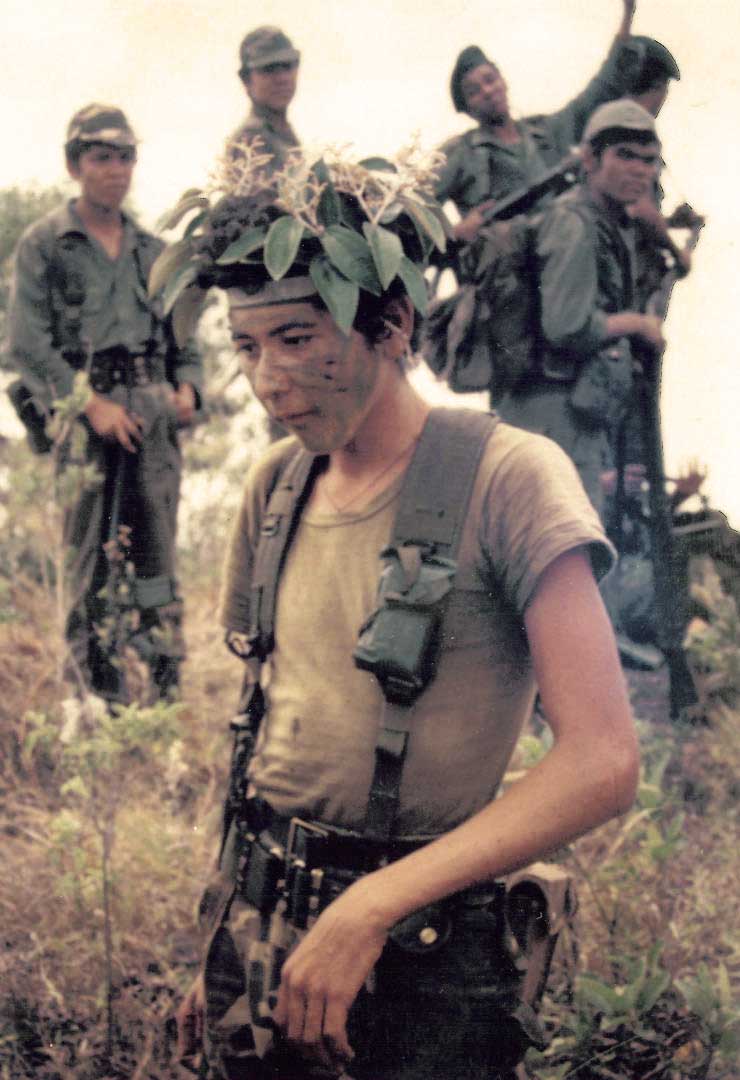
Salvadoran soldiers

Salvadoran soldiers

iend and we still keep in touch. She is now is the editor-in-chief of ReVista, the Harvard Review of Latin America.

ALL IN ALL, it was an experience I’ll never forget. And, if I say so myself, I wrote some damn good articles for The Post, and took some pretty decent photos that were used with those stories.

This great adventure ended, however, a year after it had begun, when my editor proved true to his word and asked me to fill a newly created position in the Washington bureau. It was a good thing, for many reasons. One of them was that by this time Houston’s economy had started to tank and soon there would be no profits to flow through Barbados and on to Canada, which meant that the reporter who followed me was not allowed to travel anywhere near as much as I had travelled and so he ended up spending most of his tenure there stranded in Barbados. Poor guy.

(I started writing this as an introduction to a letter I wrote from Barbados to a friend shortly after my arrival on that island. She recently found that letter and sent it to me. I was going to post it with a short introduction but the introduction turned out longer than the letter! It’s not a great letter, but I think you might find it interesting when I post it in a few days.)

Posted in Uncategorized | Tagged , , , , , , | Leave a comment

Of cats and heroes

juanzqui7's avatarjuanzqui

AMERICANS – AND many others around the world – are suffering an extreme case of the warm fuzzies in the wake of the news that three Americans, two of them service members, had joined others in subduing a terrorist as he prepared to kill as many people as he could on a high-speed train from Amsterdam to Paris.

Rightly so.

A potentially deadly situation that ended up with the good guys doing the right thing at the right time to ensure that little blood would be shed is something to celebrate, and the three Americans and others greatly deserve to be seen as heroes.

The problem is that after decades of our hanging the “hero” tag on anybody and everybody we admire, that tribute seems to have lost a good deal of its value. Everybody is a hero these days.

Anyone who puts on a military uniform is a hero.

View original post 372 more words

Posted in Uncategorized | Leave a comment

Of cats and heroes

AMERICANS – AND many others around the world – are suffering an extreme case of the warm fuzzies in the wake of the news that three Americans, two of them service members, had joined others in subduing a terrorist as he prepared to kill as many people as he could on a high-speed train from Amsterdam to Paris.

Rightly so.

A potentially deadly situation that ended up with the good guys doing the right thing at the right time to ensure that little blood would be shed is something to celebrate, and the three Americans and others greatly deserve to be seen as heroes.

The problem is that after decades of our hanging the “hero” tag on anybody and everybody we admire, that tribute seems to have lost a good deal of its value. Everybody is a hero these days.

Anyone who puts on a military uniform is a hero.

Ditto for anyone who puts on a law-enforcement or firefighter uniform.

Teachers are heroes.

Nurses are heroes. (For some reason, very few doctors are seen as heroes. Maybe it’s because we resent their high salaries?)

Mothers are heroes, unless they abandon their kids.

Some fathers are heroes, mostly those (of all races) who are heads of poor families and do not walk out on those families. Single fathers are all heroes, regardless of their economic status.

School crossing guards are heroes.

And the list goes on and on, almost to the point of including any person who does what he or she is supposed to do. In other words, any person who doesn’t screw up is seen as a hero these days.

Sometimes, however, we call people heroes because we feel more than a tinge of guilt over the fact that we don’t compensate them enough. Think teachers. Think nurses.

And then there are the other kinds of heroes, people who are good at what they do: athletes, singers, actors, dancers, Wall Street wizards, Silicon Valley geniuses.

We call them all heroes because we admire them, and respect them, as we should (most of them). Again, it is right that we recognize and honor these people.

But — as is the case with the cat in the Geico desert/quicksand commercial who ignores the guy sinking into quicksand because ignoring people is what cats do — they are simply doing what they signed up for.

And, in calling them heroes, do we not run the risk of diminishing the impact of the word when we apply it to people such as Airman First Class Spencer Stone, Oregon National Guard Specialist Alek Skarlatos, and Anthony Sadler, three of the people who thwarted the terrorist attack?

We could, of course, call them super heroes, but that term has been corrupted by Superman, Batman, Spiderman, Ant Man and other fictional characters. It would be an insult to call them that.

WE SHOULD KEEP the word hero. It’s a beautiful word. But we should be more conservative in how we use it; we should use it sparingly so that when we apply it to men like Stone, Skarlatos and Sadler, it will be infused with real meaning.

Posted in Uncategorized | Tagged , , , , | 1 Comment

Two horses and a donkey

THIS TIME TOMORROW I should be somewhere in West Texas, on my way to Lubbock, or some place near there, where I’ll spend the night before heading on to Santa Fe. I plan to visit friends there for a day or two before driving up to Boulder, where I’ll spend the next two and a half weeks.

The good news is that for that length I time I will escape Houston’s heat and humidity. (It’s not really that bad, really: I just emerged from a Starbucks into the afternoon sun and it felt damn good.) The not-so-good news is that while there I will be responsible for the wellbeing of three beings while their owner and master goes away to play all over Europe like a rich lady.

Two horses.

One donkey.

Before my friend Diane — the owner of the house where I’ll be staying and owner of the three animals — gets the wrong idea, let me assure you, and her, that I’m looking forward to being with los animales and that, while I have no experience in taking care of four-hoofed animals, I do not shrink from the responsibility.

It’s just that I am a little apprehensive about being responsible for the wellbeing of any other living, breathing animal – human or otherwise. I’ve taken care of dogs and I’ve taken care of cats and I’ve survived. In fact, enjoyed it. But that doesn’t mean I wasn’t worried that something bad would happen to them during the time I was responsible for them.

I’ve spent most of the day cleaning up my place because it must be spotless when my nephew and his family arrive in a couple of weeks to take in a couple of Astros games. I’ve also typed out a two-page list on how to do things in my apartment and where the nearest grocery stores and pizza place are. Which blinds to close on which side of the apartment at what time of day to keep out the sun’s rays. Where they can find HBO and the Astros network and other channels on the TV.

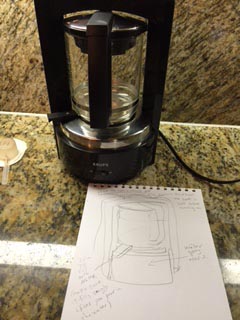
I even drew a picture of my (very different and no-longer-in-production) coffee maker to make sure they operate it correctly.coffeepot

In a while I will start packing because I want to get an early start tomorrow, as soon as I finish eating breakfast, drinking my coffee and reading my paper.

I’ve got my cameras and lenses and other photo equipment, my binoculars and bird guide books, all in one place, ready to be packed. I’ve got my sketchpads together and I just got back from the art supply store where I bought a bunch of neat pens. I doubt I’ll use them much, but a man must have pens.

I’ve cleaned out my fridge, eaten what I could and discarded the rest.

ONE OF THE joys of road trips for me is taking a road never before taken, and I’m going to do that this time. On the advice of my friend Laura, I’m going to get to New Mexico without driving much in interstate highways. I am driving west on I–10 but only to Sealy, where I’ll get in State Highway 36 to Abilene, I believe. From there I’ll take another state highway to Lubbock and another into Clovis.

From Sealy to Clovis will all be new territory for me. (Laura actually recommended I take 290 to Brenham and 36 from there, but I refuse to drive on 290 because it has been designated the Ronald Reagan Highway.) My New Mexico and Colorado routes (also non-interstates) will be familiar, but they are beautiful roads and I am eager to drive over them again.

I still haven’t decided my return route, but it will probably involve going driving through parts of western Oklahoma, an area of the country I’ve never seen.

SO, WHAT DO I plan to do while in Boulder? I don’t really know. I now this much: I won’t be riding the horses. Never ridden one in my life and I don’t intend to start now.

My friend lives outside of Boulder, in the mountains (or foothills – I haven’t figure it out yet), and the area has numerous state and national parks and forests, so I will probably do a little hiking. I will explore Boulder and drive into Denver to visit its museums and other attractions.

I’ll take pictures and maybe do some sketching. And I have friends nearby that I plan to visit. But I also hope to just take it easy, catch up on my reading (yes, I just started reading “Go Set A Watchman”) and maybe a bit of writing.
And, oh yes, take care of the horses. And the donkey.

Posted in Uncategorized | 2 Comments

And my favorite Willie Nelson song is …

THANKS TO EVERYONE who took the time to post a Willie Nelson song on my timeline yesterday. Thanks for humoring me and thanks for sharing your love for the talent of this great artist.
I spent much of yesterday watching and listening to those YouTube videos that you all posted. Most I’d heard before and have enjoyed immensely over the years, but there were a few that I had never heard – or heard of – before.
The rules of the game were simple: post a video of your favorite Willie song and at the end of the day, if any of your favorites matched my favorite Willie song, you would be designated the winner to receive a piece of original art from me. If there was more than one match, I would place the names in a hat and pick a winner.
However, in trying to decide which is my favorite, I hit a big stumbling block because I couldn’t choose from the top three, so I went with all three. And it turned out that three people posted one of my favorites, and rather than having to pick a winner, I’ve decided that all three will get some artwork.
Interestingly, although Willie has written many, many beautiful songs, my three favorite Willie songs are songs somebody else wrote. Here they are, my favorite Willie songs, not necessarily in this order:
Blue Eyes Crying in The Rain
Written by Frank Rose and first recorded by Roy Acuff, in 1945, “Blue Eyes” had been recorded by numerous artists, including Hank Williams, Ferlin Husky, Conway Tweety and Loretta Lynn, Slim Whitman before Willie included it in his concept album, “Red-Headed Stranger.” It was “Blue Eyes” that re-launched Willie’s career in 1975. Before this, his success had been primarily in writing songs for others. Others recorded this song since (including Elvis) but no one has had the success that Willie enjoyed.
He Was a Friend of Mine
Willie’s beautiful interpretation (used in the film, “Brokeback Mountain,”) is as soulful and haunting as the original — called “Shorty George” and recorded by an inmate named Smith Casey at the Clemens State Farm in Brazoria County, TX, in 1939 — and Bob Dylan’s version. An elegy to a dead friend (presumably a fellow inmate), it evokes sadness, longing and helplessness. The Byrds recorded a version of this after JFK’s assassination. For a more thorough exploration of this song and its many versions, go to Joop’s Musical Flowers.
Can I Sleep in Your Arms
This is also from his “Red-Headed Stranger” album. It was written by Hank Cochran for his then-wife, Jeannie Seely. Titled, “Can I Sleep in Your Arms Tonight, Mister,” it was released in 1973 and was her first major hit. The song shares a melody with the traditional cowboy song, “Red River Valley.” I’m not sure if Cochran adapted his version from another version, called, “May I Sleep in Your Barn Tonight, Mister.” Both versions are about abandonment and loneliness and the need for human contact. Seely’s version is simple and beautiful, and so is Willie’s, but his inclusion of soulful piano, guitar and harmonica solos give it a depth that really pulls at your heartstrings.

Posted in Uncategorized | 1 Comment