Election season predicament: desperately seeking our horse

ALMOST SIX YEARS ago, as we were approaching the mid-term elections, I spent a beautiful Saturday autumn morning watching the Howard University homecoming parade not too far from where I lived in Washington.

Among the many participants were about a dozen horse riders, in cowboy attire, bringing up the rear. Most of them were African-American, but a couple of them were white, and there was one Latino. They seemed a bit out of place – a stark contrast to the souped up cars and motorcycles that preceded them – but they were having a great time, and the kids along the parade route loved them.

As I was walking home after the parade, I noticed one of the cowboys walking on the street, talking on his cell phone. His compadres were nowhere to be seen and I assumed that he was probably on his way to join them, wherever they were.

Hardly anybody paid any attention to him, until a street person started walking next to him and yelling, at the top of his lungs, “You lost your horse! You lost your horse!”

They cowboy paid him no mind and kept on talking on the phone. How he could hear the conversation is beyond me as the street person kept screaming, “You lost your horse! You lost your horse!”

Finally, the cowboy could take it no longer. He put his cell phone on his chest, turned to the street person and said, “Yeah man, I lost my damn horse.”

That did it. That’s all the street person needed to leave him alone, turn around and head back the other way. And the cowboy returned to his phone conversation and continued on his way.

AS WE APPROACH another big November rodeo, I can’t help thinking that there is probably no better description for our national situation: We’ve lost our damn horse!

Worse, the most foolish rodeo clown that has ever existed is trying to lead the parade.

[Disclosure: I recycled this from my old blog, http://www.puckintheface.wordpress.com]


Posted in Uncategorized | Tagged , , , | Leave a comment

The accident, and that v-shaped scar on my mother’s forehead

IN 1951, MY sister Delfina eloped and that summer went with her husband’s family to work in Ohio.

“Se la robó,” we would say about our brother-in-law Pedro: he abducted her. That’s how the running away of a young couple was described, as if the woman had nothing to do with it, as if she was an innocent victim. Much later I was to find out that the phrase originated with the Moors during their conquest of Spain, but back then, no one felt any need to analyze the words; we knew what they meant.

Fina was the first one to leave our family, and it was as if she had flung open the floodgates: within a year, my oldest sister María Luisa would also elope and move away, and then my older brother Alejandro – Jando – would quit school and go off to the Air Force. (Each one who left meant one fewer hand to help out in the fields. My sisters’ departure was especially painful, for they had practically been supporting the family for years with their work at the Del Monte cannery.)

That June, Buelita Manuela, my father’s mother, died. She had been sick for a long time, after having suffered a stroke that incapacitated her. Tía Benita, her only daughter, my mother and the other daughters-in-law took care of her during her long illness, as did my grandfather.

We didn’t see much of Buelita after she became ill. The adults must have thought we would only get in the way. My grandparents lived in a small, two-room house behind Tío Adrián’s equally small house, which was next door to our house. Before my grandmother became sick, she would have us at her place often. Most of the time it was to feed us some of her warm, hot-off-the-comal corn tortillas that she rolled up in tight, moist burritos after having sprinkled salt on them. Often she would lure us with her tortillas and then ask us to kneel down to pray with her.

That year that Fina left us we were scheduled to return to North Dakota for the summer, but when it became apparent in late April that my grandmother was near death, we stayed in Texas. Not only would it have been disrespectful to have left when she was on her deathbed, but my mother was needed to help take care of her.

We kids suspected that she was dying, even if no one bothered to clue us in as to what was going on, so we stayed out of everybody’s way. On the evening that she died, they sent all of the children to Tía Benita’s house while the adults gathered around her bed, or – in the case of the men – stood outside around a fire, smoking and talking in low voices. Although we knew Buelita was dying, most of us didn’t know how to behave, what we were supposed to do. We had not witnessed death before. So we did the only thing we knew how – we played games.

At last, after many hours, one of the tías walked in and announced simply, “Ya murió.”

We buried my grandmother a few days afterwards, in a wooden coffin that my grandfather, a carpenter, had made. She was buried at the camposanto Benito Juárez, the Mexican cemetery at the edge of town whose main entrance was spanned by a crude metal-and-wood arch with a message, a plea, which could only be read as people exited: No se olviden de nosotros – aquí estamos y aquí los esperamos (Do not forget us – here we rest and here we will wait for you).

BY THE TIME my grandmother had died and been buried, it was too late to go to North Dakota; the sugar beet work had started weeks earlier and the farmers had all the crews they needed. There was no place for us to go. For a while we thought we would have to spend the summer in Texas but then we got word that Del Monte was looking for people to work at its tomato cannery in Ogden, Utah.

Utah? Hardly anybody had heard of that state. Where was it? What was it like? Nobody could tell us. One neighbor told my mother that the state had just been invented.

Apenas lo inventaron, she said confidently.

We kept hearing horror stories about the scary mountains and their steep cliffs over which our car would have to travel in order to get to Utah. We had visions of our car going over a voladero and hurling us down a mountainside to our deaths. I worried that the car would be unable to manage the steep grades on the mountain roads and we’d end up rolling uncontrollably down to the bottom.

None of that happened, of course. The mountains were there but none was as formidable as we had imagined. Nevertheless we breathed a sigh of relief when, at the end of the third day, we crossed the Wasatch Range and entered the valley in which Ogden lay. We had made it. We were safe.

Well, almost. About 30 miles from Ogden, a drunk driver crossed the median onto our lane and rammed our car head-on. We had conquered the mountains but we were stopped cold on a flat, straight highway a few miles from our destination. Nobody was hurt, but we must have been quite a sight. There had been nine of us stuffed into that old car – five adults, one teenager and three children – and every nook and cranny had been stuffed with people, clothes, blankets and pillow, pots and pans and other belongings that we would need that summer.

Although the car was not badly damaged, its radiator had to be replaced and it needed other minor work. It would not be able to move for a few days, so while my father and one of my brothers stayed behind to supervise the repairs, the rest of us boarded a bus for the final miles, lugging our blankets, pillows and duffel bags stuffed full with clothing. That was the first time most of us had ever ridden on a bus. We were still in a state of shock over the wreck and we were nervous in anticipation of the arrival at our new home. The excitement and tension was too much for Carmen, my youngest sister who, at six, was a year older than I. Standing meekly between my mother and Luisa, my oldest sister, Carmen peed in her panties. None of us said anything as we watched the stream make its way towards the front of the bus, but we prayed that the bus driver wouldn’t notice it. The last thing we needed at that point was to be abandoned on the side of a strange road by an irate bus driver.

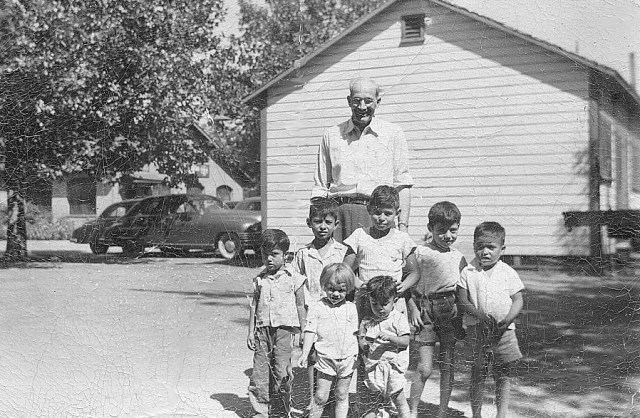
me,utah,1951

That’s me on the far right. I don’t know who most of the other kids are, other than Armando Solis, the tallest one. The man was the Del Monte plant manager, I think. The building in the background was one of the barracks that housed the migrant families.

When we got to the camp, a row of white barracks next to the giant plant outside Ogden, our official greeting party consisted of the Herrera triplets. The Herrera family, also from Crystal City, had arrived several weeks earlier so the seven-year-old triplets – Clotilde, Beatriz and José – apparently felt obligated to let us know from the very beginning that in this camp, they were in charge.

“Que bueno que se les murió su abuelita,” they would taunt us when the adults were not around. They also ridiculed us for having arrived on a bus, for having been in a wreck, and for whatever else they could think of. Eventually they became our friends and playmates, but those first few days, they forced us to stay inside because we could not bear their teasing.

MOST OF THE summer only the adults worked because the cannery would not employ teenagers or children, so Mariana, who was 14, took care of me, Carmen and 8-year-old Dora. It was an easy time for her because, in addition to the Herrera triplets, there were other children in the camp and we spent a lot of time playing with them outside. Unlike places where we’d worked in other states, this was a clean, well-kept camp. The apartments were large (ours had four rooms) and well-constructed, not drafty and dusty like the ones we were used to. They even had indoor plumbing – a first for us – and a regular kitchen with a gas stove and a refrigerator. There was even a small park with swings and other playground equipment.

By the end of the summer, though, the cannery was slowing down. Only my father and Jando were working there. After a while, my mother, Norberto and Mariana started joining others who would go out to pick cherries in the nearby orchards. For some reason, Luisa stayed behind to take care of us, allowing Mariana to go out. Each morning they got on the back of a truck owned by Ramón Montemayor – the crew leader, also from Crystal City – and rode to the orchards. The same truck would bring them back home in the evening.

One morning Dora insisted on going with the others to pick cherries and my mother, tired of listening to her nagging, said yes. That evening, on their way home, the driver of the truck was going a bit too fast and failed to make a curve near a softball field where a game was going on and the truck flipped over a couple of times before landing on its back. Most of the 30 or so people aboard the truck were pinned under it as its wheels spun silently above; a few were hurled into the ditch. The panicked softball players scurried to help pull people from the wreckage while they waited for the ambulances to arrive.

Back at the camp, we could hear the wailings of the ambulances as they moved back and forth between the site of the wreckage and the hospital. We all stopped what we were doing and stood at the edge of camp looking in the direction from which the sirens could be heard. They seemed to go on forever. I think we all knew by then what had happened, but, at five years of age, I don’t think I had sense enough to realize what the implications were.

I don’t remember anyone telling me that my mother and Mare (pronounced MAH-reh) and Beto had been injured and would not be coming home that night, but somebody must have. I don’t remember crying. I don’t remember complaining or even being scared, but I’m sure I must have done and been all that, and more. I was very close to my mother and I had never really been separated from her for more than a day or two – I can’t imagine remaining calm when faced with the knowledge that she would not be coming home anytime soon. Maybe I’ve chosen not to remember.

Montemayor quickly reassured everyone that the truck was insured, that all the hospital and medical bills would be taken care. We needn’t worry. We didn’t, but months later, after we’d return to Texas, we started getting bills from the hospital, and they continued to come for years. I think my mother made an effort to pay some of the debt but there was no way we could pay everything and the hospital eventually gave up trying to collect. Montemayor left the camp very soon after the accident and we never heard from his insurance company, if he had one.

Dora was the only one to come home that evening. She was unhurt. Mariana came home a few days later, missing her two front teeth. Beto was next. His broken nose was badly disfigured and his head was wrapped in bandages from the eyes up. His forehead was to remain a terribly sensitive area until he died in a Texas car accident fifteen years later. My mother, however, remained in the hospital for weeks. The impact had literally lifted most of her forehead from her skull. Some forty years later, it was the V-shaped scar stretching from one end of her forehead to the other, her recuerdo from that horrible day in 1951, that I stared at as the funeral director closed her casket.

ON THE DAY she finally came home, Luisa and Mare had bathed Dora, Carmen and me and made us put on clean clothes and our best shoes. They wanted her to find us presentable. It had been a long time – they had not allowed us kids to visit her in the hospital – and we were dying to see her. But when she walked through the door into our house, my eyes locked on the white bandage wrapped tightly around the top of her head and I went into virtual shock. Although I had the decency to stay there long enough for her to hug me and my sisters as she sobbed, “¡Mis hijos, mis hijos!” Somehow I managed to wiggle out of her embrace and quickly left the room.

I was scared of her. Of her bandages. Of this different woman. I was not sure she was the same mother who had left us that morning many weeks earlier. I did not want to be around her. I did not want to have to see her. Eventually the shock of her bandages wore off. Eventually I realized what a terrible transgression I had committed. And I often wondered what could have could have gone through her mind as she saw her own child rejecting her.

If she was hurt, I never heard about it. She was not the type of person who would keep past transgressions handy to hurl back at her children when convenient. No doubt she forgave me, even without my having to ask for forgiveness. She was very good at that.

It took me a long time to forgive myself for what I had done, however. And maybe I never did. Maybe that’s why I was staring at that scar on her lifeless forehead that final day.


Posted in Uncategorized | Tagged , , , , , , | Leave a comment

How Tommy found Kathye: Connecting a dying man to his high school sweetheart

SEVERAL DAYS AGO I woke up to a notice from WordPress, the outfit that hosts my blog, that someone had left a comment on one of my posts. Given that my blog attracts very little traffic, and that I hadn’t posted anything in days, I was naturally curious about the comment, so I quickly logged on and read the following, at the bottom of a blog I had written in May of 2015, about my high school days:

“What ever happen to Kathy Brisco, I am looking for a Kathy Brisco from crystal city from the year 1960 To 1964,,,,A friend of mine John Brannon is searching for her, text me at xxxx. Thanks Lillian”

At first I was bewildered by the question. Why would anyone believe that I had any idea where this person was? But then I remembered that in that post, I had written about my most memorable moment at Crystal City High School.

This is what I wrote:
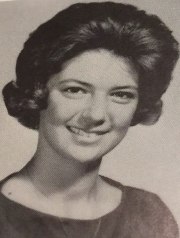
Kbriscoe

Kathye Briscoe, Crystal City  High School yearbook, 1964

If I had to pick a most memorable moment of my high school years, it would have to be that early Friday afternoon in November — during my sophomore year — when I was walking down the hallway that connected the auditorium and the main hallway. Our lunch hour had ended and we were all heading back to our classes. In the middle of that hallway I saw Kathy Briscoe heading in the opposite direction, with tears in her eyes.

“They shot him,” she said.

They cancelled classes a few minutes after that.

It was clear that this Lillian person had done a Google search on “Kathy Brisco” and “Crystal City High School,” and that the search engine had given her my blog post.

Why she thought I might know the whereabouts of Kathye Briscoe (the correct spelling of her name, I was to find out from my sister’s high school yearbook) was beyond me. I had known Kathye. She was a classmate and we had a number of classes together. I’m sure that during her three years at CCHS we exchanged many words, but I doubt we ever had a serious conversation about anything. We definitely weren’t friends. In those days there was almost no socializing between the Anglo and Mexican kids, and even if there had been, I was definitely not the kind of guy with whom a girl such as her would want to spend too much time.

tbrennan

Tommy Brannan, CCHS yearbook, 1964

Kathye was a popular, intelligent and attractive olive-skinned girl, always smiling. I don’t think I ever heard her say a cross word to anyone. Her family moved to town during our freshman year, when her father became manager of the local JC Penney store. They lived in a modest house on East Crockett Street, next door to the big house occupied by the local banker.

Soon after arriving, Kathye and Tommy Brannan became an item. Tommy was the son of a local schoolteacher and he was a year ahead of us in school. He was a jock, a star in football and baseball, and maybe even basketball. He and his best friend, Bob Taylor, the son a local lawyer, were Big Men on Campus. Loud. Boisterous.

Tommy and Kathye seemed like an odd, unlikely pair to me. She was refined, diplomatic and courteous. She didn’t seem to relish being the center of attention. He loved it. As unlikely as it seemed, however, the relationship thrived and I think everyone assumed the two would end up getting married. Then, at the end of our junior year, Kathye’s father was transferred to another store in another town and Tommy went off to try to be a college jock and that relationship ended. I never saw or heard of Kathye again.

AND THAT’S WHAT I told Lillian, in my email responding to her comment on my blog post: I had no idea where Kathye was and I doubted I could find her if I tried.

I thought that would be the end of that, but the next morning there was another notice of another comment on the blog post, this one from “John Brannon”:

“How can I find Kathy Briscoe, I am a friend of hers and I am very ill. I just want to thank her before I get to where I pass away thanks,,I live in SeguinTexas”

Now that got my attention!

I was pretty sure it was Tommy Brannan. I remembered, from reading my hometown weekly newspaper in years past, that he had moved to Seguin, gone into business and started a family there, and I thought I remembered that his name was John Thomas Brannan. So that all made sense.

But why would he misspell his own last name?

It then occurred to me that perhaps Tommy was too ill to write on his own, that maybe somebody else – Lillian, perhaps? – was doing the writing for him.

I posted this response:

“John, I really, really wish I could help you, but I have absolutely no idea where Kathy might be. I am sorry that you are ill and I truly wish I could help find Kathy for you. Unfortunately, my blog posts rarely have more than 100 readers, if that many. I know you call yourself John, but I think I may be right that you went by Tommy in high school. Is that correct? You were a year ahead of me in high school. I doubt you’d remember me; there’s no reason for you to. But I remember you. I hope you do find Kathy. I can’t say she was my friend, but we were classmates and were in several classes together. I have nothing but fond memories of her.”

WITH THAT, I thought I had gracefully excused myself from any more involvement in this intriguing and sad tale. I had asked myself what obligation I had to help this man from long ago, who had been briefly in my life but never a part of it. He was a stranger, really.

It is no secret that I have strong negative views about growing up in South Texas at a time when the small Anglo minority had all the power and treated us as second-class citizens, or worse. Tommy was very much part of that establishment.

Further, I had checked with my sister Carmen, who had been his classmate, and not only did she have no fond memories of him, she had one very nasty recollection: As a child, she was walking past Tommy’s house one day and he had come out on his front yard from where he started throwing rocks at her. And he laughed as she dodged and ran.

I wanted my response to his comment to be my last involvement in this matter. I really did. But two things prevented me from doing so. The first was that this guy – John, Tommy – claimed to be dying and he needed help on something he felt was important to him. There may not be a warm place in my heart for some people, but that heart – this heart – is not a cold heart. Didn’t I have an obligation to try to help another human being in need if I could?

The second thing was that my reporter instincts had kicked in. I had been presented with a challenge, an assignment, if you will, and I felt a need to pursue it, to try to find the answer to the question, “Whatever happened to Kathy Briscoe?”

SO I BEGAN the search, using the two web instruments I am most familiar with, Google and Facebook. They turned up nothing. I had reached a dead-end almost before I started. There are lots of Kathy Briscoes on FB, but not the one I was looking for.

But then I asked my niece to go to Carmen’s yearbook and take a picture of both Kathy’s and Tommy’s class photos. When I got them, I noticed that there was an “e” at the end of Kathy. It was Kathye, not Kathy.

Back to Google I went. It took a while, but I learned that she probably lived in Raymondville, north of Harlingen, and that her last name is now Austin – and that her husband had died several years ago. I learned that one of her sons had married a girl from Montgomery not long ago. But I couldn’t locate a phone number for her (even though a while ago I tried to replicate my search and came up with a phone number right away; go figure!).

I returned to Facebook and learned that even though she is not a FB member, she has friends who are, and some of them mentioned her. There was one post of a group of friends driving from Raymondville to Houston to see the opera Carmen, praising Kathye for her driving skills. Others mentioned going to the movies with her in Harlingen, and there was a picture of a group of women at a dinner, posing for the camera. There, near the middle of the back row stood a woman who looked very much like Kathye. She was also mentioned by the Raymondville Methodist Church’s pastor. In one of his posts, he asked for prayers for Kathye and her family as they prepared to remove her husband from life support. I called the church but no one picked up the phone.

I clicked on the church’s page and found more photos featuring her in the choir and other church activities. The photos left no doubt: this was the Kathye Briscoe I remembered. But I still didn’t have any contact information for her.

Meanwhile, while waiting to figure out how to proceed on that end, I did a Google search on Tommy. I learned that in addition to owning a pharmacy, he was in real estate, selling and buying ranch and hunting properties, and that he was involved in local politics. There was a letter he had submitted to the local commissioners court asking to be appointed to fill a vacancy on the court, and there was a story about his running for county judge in the GOP primary, pledging to run the county like a business. I also found an obituary for his mother, who is buried in Crystal City.

Tommy had included his phone number in the news story in which he announced his candidacy and I decided to try it. It was not an easy decision. For all I knew, Tommy was on his deathbed, barely able to move or talk, and the last thing he or his family needed was someone calling to tell give him information about an old girlfriend.

All this brought back memories of all the times that, as a reporter, I had to call grieving families to get a comments or information for articles I was writing. I hated doing it and I put it off as long as I could but in the end I called because I had to.

I DIALED THE number but there was no answer. Instead there was a message, recorded by Tommy’s unmistakable voice, saying nobody was home but to please leave a message. I did, telling him that I was pretty sure I knew where Kathye was but that I had been unable to get her phone number. I left my phone number if he wanted to call me back.

He did, identifying himself not as John but as Tommy, and sounding very much like the good old boy I remembered. And, to my relief, he sounded healthy. Or, if not healthy, certainly not like a man on his deathbed. We talked about high school and about people we knew. He admitted he didn’t remember me and I replied that there was no reason for him to: he was a jock and I wasn’t and we never had any classes together and we certainly didn’t socialize. He talked about his dreams about becoming a college and pro athlete, and about how those dreams were shattered when he discovered that at the college level, you have to be better than good to succeed.

“You think you’re going to make it because you’re good in high school – I was a big fish in a little pond – but you quickly learn that everybody is good at the college level,” he said. “And at the pro level, everybody is special.”

The conversation got around to Kathye and why he was looking for her. He explained that he’s been spending a lot of time trying to reach out to as many people who have been part of his life as he can, to let them know how much he appreciates their friendship. He’d talked to a lot of people, “but Kathye kind of just disappeared. Nobody seems to know where she went.”

He didn’t tell me how close he is to death and I didn’t ask. He thanked me for my efforts. I mumble some words about how sorry I was about his health, and before I hung up I gave him the Methodist Church’s number.

NOW IT WAS back to finding Kathye. I went back to FB and sent text messages to each of the friends who had mentioned Kathye in one of their posts. I told them who I was and why I needed to speak with Kathye. I didn’t mention Tommy’s health because it somehow didn’t seem right, but I tried to make it seem as urgent as possible, while going out of my way to not sound like some sort of stalker. I didn’t ask for her phone number or e-mail address, but I listed mine and asked them to ask Kathye to call me.
hsband

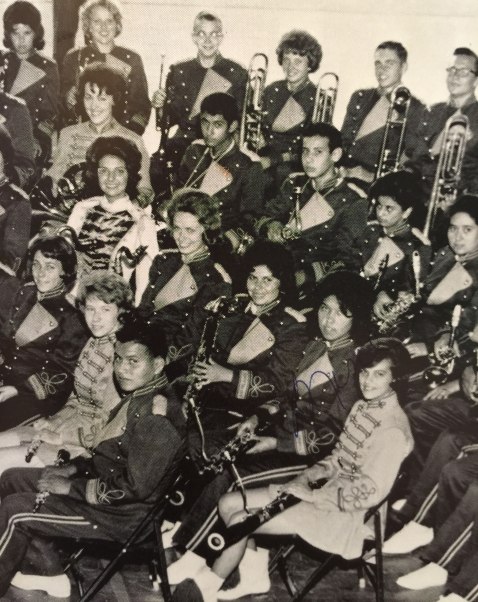
CCHS Band picture. That’s me, bottom left, and Kathye Briscoe is above me in the white drum major uniform.

“I don’t know if she’ll remember me, but if she does, it’ll probably be as Johnny or John, which is what I was called back them,” I wrote. “Tell her I played oboe in band.” Kathye was also in band and she played the bass clarinet, which meant she sat close to me in the wind section. She was the drum major for the band, and in a yearbook photo my niece sent me of the band, she stands out in her white drum major outfit in a sea of dark-colored uniforms.

I didn’t get any immediate responses but I knew that my text messages had been read because I looked at the statistics page of my blog and saw a quick uptick in the number of readers of that particular post that day.

After about an hour, I got a reply from one of her friends who said that, yes, indeed, I had the right Kathye. She always talked a lot about her years in Crystal City. Kathye would call me that evening, she promised.

Sure enough, about five o’clock my phone rang and I noticed that it was a Harlingen number. I picked it up.

“Johnny?”

Her voice sounded just as I remembered it. After all these years, how is it possible to remember the voice of a person who was never even that close to you?

“Of course I remember you,” she said, mentioning some of the classes we took together, and band.

She said she hadn’t spoken to anyone from her Crystal City days in a long time, except for one time several years ago, at a social function in Waco, when she overheard someone talking about Tommy and Susan Brannon of Seguin, and about Tommy’s illness. It turned out to be a classmate of Tommy’s.

“My God, that is the man I was supposed to marry!” she recalled telling herself.

We talked a bit about her years in Crystal City, about where she moved to after she left (San Antonio), and about people we remembered. She also talked about her family and life in Raymondville.

She wasn’t surprised when I told her why I was looking for her, about Tommy’s need to reach out to her. She said she would call him, and I gave her his phone number. I asked her if she would call me back after she did to tell me about the conversation and she promised she would.

She hasn’t. It’s been only three days but I really doubt she’ll call, and I can’t say that I blame her. Whatever conversation she had with her ex-boyfriend, it can’t possibly be easy to talk about.

I COULD CALL her back, or I could call Tommy, but I won’t. The thing is, I’m no longer a reporter and I don’t have to. I’ve done my job and this is where I have chosen to place my reporter instincts on hold.

I hope Tommy is able to talk to Kathy – and to all those in his past he has been trying to locate – and I hope he has found peace or whatever else he is looking for by reaching out.

And if a conversation between these two former high school sweethearts did take place, it’s their conversation, and that’s how it should stay. I don’t have to know.



Posted in Uncategorized | Tagged , , , , , , , , | 4 Comments

Scenes from a flight: Cheese Nips, peanuts and clouds – and that woman in the bathroom.

LADIES AND GENTELMEN, the captain said, if you’ll look out your window, you’ll see that there’s a thousand miles of thunderstorms over New Mexico and Arizona. This was not long after we had left the Las Vegas airport, which has to rank among the ugliest, most depressing in the country

I was forced to take the captain’s word for it because the weary passengers near me had all opted to keep shut the shades on their windows, blocking any chance of seeing those thousand miles of storms. That is, until the woman occupying the window seat on my row, the one wearing a black baseball cap with rhinestones and imitation pearls covering its beak, became curious and lifted her shade. By then, however, the thousand miles had become three hundred, or maybe less, and the few clouds with a fondness for flair or fanfare were faded mutations of the ones my mind had imagined when The Voice first came over the PA system.

***

I DO NOT want the last taste of solid food that will be with me for the rest of this flight to be that of the solitary peanut that had stowed away in the otherwise empty and crinkled package of Southwest lightly-salted peanuts, not after I have treated myself to the crunchy contents of the orange and purple bag of Nabisco 100-calorie Cheese Nips. But the Nips are gone and the Palomo Rule of Survival dictates that no piece of food, not even a measly salted peanut, will go unconsumed. And who am I to disobey the rule?

***

THE WOMAN ACROSS the aisle from me, the one seated next to the two old lesbians, is cold. A light hoodie that belongs over her head and shoulders is instead draped over her pale skinny knees. Instead, what covers her long red hair and her emaciated face is a scarf in pageant pink and SeaWorld cerulean. If it weren’t for the colorless skin of the small part of her leg that is not covered by the hoodie, it would not be difficult to suspect that a Middle Eastern woman, a devout Muslim, is sitting there under that tent, looking out at the enclosed environment through the gauzy fabric of the scarf, perhaps plotting against the rest of us.

As I watch her, a soft sneeze suddenly erupts from underneath the scarf. It briefly lifts a small portion of her multicolored veil, forming a spiritless tuft that, like the ghost that it is, dissolves as quickly as it materializes.

***

I HAVE CHOSEN an aisle seat fairly close to the front of the Boeing 737-800. On longer flights I do not like to be forced to climb over other passengers when I leave my seat go to the bathroom. Because of the thunderstorms, the captain has kept the fasten-your-seatbelts sign on longer than normal, and when the light finally goes off, I make a quick dash toward the front bathroom. I have not seen anybody going in there, so I assume that it is empty, an assumption that is proven correct when I see the green “vacant” sign on the door.

Or so I think. When I open the door, I see an old woman bent over the toilet, as if reaching back to press the flush button. She is fully clothed, thank God, but as she turns around to look at me, there is no panic, no look of shock on her face. It’s as if having a stranger walk in on her as she performs her most private of functions is an everyday occurrence.

I don’t even bother to say oops, or I’m sorry. I just close the door and turn to walk back to my seat. “Was someone in there?” the flight attendant asks. I nod. “Some people,” she says, shaking her head and chuckling.

***

ABOUT THOSE CHEESE Nips. I want more, particularly after my two bourbons-on-the-rocks arrive. With every sip I take, my mouth hungers for those cheesy delights. Sip … Nip, my brain keeps telling me. Sip … Nip. When the flight attendant comes by to collect the trash, I am hoping, praying that she’ll repeat the words I have heard her utter to other passengers: Anything else I can get you?

She does, and I want to kiss her hand. Instead, I calmly and playfully ask, do you have anymore of those Cheese Nips?

That’ll be four dollars, comes back the cold reply.

My mind tells me that cannot possibly be right, but my face must be telling her that I believe her, for she quickly pats my shoulder and reassures me: I’m just kidding. I’ll get you some.

She never does.

Posted in Uncategorized | Tagged , , , , | Leave a comment

My nightmares

LISTENING TO young Karla Ortíz addressing the DNC, talking about her fears that any day her immigrant parents might be deported, brought back some painful memories from my childhood. I had those fears. Not every day, but there were enough of those days to leave a mark. Both of my parents came to this country without papers. They were wetbacks. Mojados. When we were in our South Texas community, one family among hundreds who had family members like my parents, undocumented. But every summer, when we went up north to work in the field of North Dakota, Wisconsin or Minnesota, inevitably there would come the day when we’d look up from the rows of sugar beets — or onions or cucumbers — and we’d see the green government vehicles, and we’d see the men in green uniforms exit and make their way from family to family, checking on their immigration status.

The reality was that my parents were in no danger of being deported. They had been in this country for such a long time that for all intents and purposes, they were considered legal residents by our government.

But I didn’t know that. Ten-year-olds don’t know the intricacies of immigration law. All I knew then was that these men in green, with guns on their hips, had the power to take my parents away from me and my siblings and transport them back to Mexico, leaving us to fend for ourselves.

THAT’S WHAT I knew. That’s what I feared. That was my nightmare all those many years ago. That children today, 60 years later, are still facing the same fears, is our national nightmare. Our national shame.

Posted in Uncategorized | Tagged , , , , | Leave a comment

On languages, culture and civilization – and a genuine apology

THE CLAIM BY Iowa GOP Congressman Stephen King the other day that white people – or people from the United States and Western Europe – are the only ones who have made a contribution to civilization reminds me of a day in 1988 when I was sitting in a Houston federal courtroom, substituting for the regular federal courts reporter.

At issue before U.S. District Judge Woodrow Seals was whether undocumented immigrant children were entitled to a free education in Texas (he later ruled they did).

It had been a long, dreary day of testimony from various experts when I heard Seals ask a witness what struck me as a stunning question to a witness who had claimed that Texas schools had the capacity to handle both English and Spanish-speaking students.

“Why should English students have to learn Spanish when they ought to be learning Russian, German, Chinese of Japanese?” he asked. “I have never seen anything of worldwide importance written in Spanish.”

He added that all major scientific works are published in Russian, Chinese, Japanese, German or English, and that most important literature is being published in or translated into English.

Sitting there in the courtroom, I was in a state of semi-shock. Surely a federal judge had not just uttered the words I had heard and written in my reporters’ notebook ­– especially not a judge who was considered to be rather liberal (he was an LBJ appointee to the bench and had served as a U.S. attorney, appointed by JFK on the recommendation of liberal icon Sen. Ralph Yarborough)!

Had I heard right? Or had I misinterpreted something Seals had said?

If the judge had indeed said what I thought I had heard, that would be the lead of my story the next day, and that would be the headline. What if I got it wrong? What would I tell my editors and my colleagues? What would I tell the judge?

All these thoughts were scrambling through my mind while testimony continued and I attempted to take notes.

Finally, the session ended and I raced back to the newsroom to write my story. For a brief moment I thought about trying to interview Seals to confirm that he had made that claim, but I quickly ruled that out. I feared that if I did so, he would realize the significance of what he had said and could claim that he had said no such thing, and it would be my notes against the word of a highly respected federal judge.

So I decided to go with my instincts, to trust my ears. I wrote my story with the following lead:

“U.S. District Judge Woodrow Seals Friday questioned the need for public-school students to learn Spanish, saying he has never seen anything of worldwide importance written in Spanish.”

I included the quotes cited above.

(The headline was typical Houston Post euphemistic: “Seals questions necessity of public-school Spanish”.)

The testimony took place on a Friday and the next court session would not be until the following Monday, so I had the whole weekend to worry about the possible reaction by the judge. Would he blast me and humiliate me in public? Would he call my editors and demand a retraction? A pleasant weekend it was not going to be.

My worries only increased when I looked at the Chronicle the next day and saw no mention of the Seals remarks. Neither had there been radio or TV reports about them. It was my neck and my neck alone that was sticking out.

But on Monday, to my great relief, instead of anger, Judge Seals expressed remorse. In a statement he made before testimony began, Seals read a letter he had written to Rice University Professor James A Castañeda, who had protested the judge’s remarks.

The quotes, he said, “do not reflect my opinions about Hispanic people, the Spanish language, or culture. It was a most senseless statement for me to make.”

His words were dreadful, he said, “and I am extremely sorry.”

Not once did he try to deny them or claim that they were misunderstood or taken out of context. (I checked with a former journalism law professor who told me that such apologies from the bench were extremely rare.)

THAT WAS NOT to be the last time I would set aside caution and fear and trust my instincts as a reporter, and I think I can thank my experience with Judge Seals for that.

I never got to speak with Seals. I would have liked to, for I admired him for his honesty, and for his willingness to admit that he was wrong and apologize for it. In this day of non-apologies and mealy-mouthed semi-apologies, Seals’ candor would no doubt stand out as refreshing.


Posted in Uncategorized | Tagged , , , , , , , | Leave a comment

Once a migrant worker …

THE GREAT López-Palomo Family Reunion is now history. I am sorry that circumstances prevented my sister Mariana, and others, from attending. The gathering was a huge success but it would have been so much better to have them there among the rest of us.

I first came up with the idea of a reunion more than a year ago and finally decided to push for it and pick a date about a year ago, not really knowing whether we could pull it off. Over that time period, I spent more time worrying about what needed to be done to make the reunion a reality than I did actually doing those things. But, with the valuable assistance of my niece Elsa Pipes and others, we managed to take care of them.

Still, my concerns continued, fed by the self-knowledge that I am a disorganized organizer and a terrible leader. The reunion took place over three days, starting with a poolside get-together at a nephew’s beautiful place outside of town (thanks, Pete and Jeannie) and ending with a backyard gathering Sunday afternoon at the home of María Luisa, my oldest sister. The main event was the reunion at a veterans hall in Gilroy.

I managed to fret about how each would go up until the moment they started. And each time after everyone had gone home, I asked myself: What the hell were you worried about? Don’t you know your own family? Don’t you know that this bunch of wonderful and wonderfully crazy people instinctively knows how to have a blast, and they need neither meticulous organizers nor elaborate plans nor fancy venues to do so? Don’t you know that the only thing these people need to enjoy themselves is to be with each other?

One of highlights was a talk by niece Sandy Gonzalez-Palomo about the extensive genealogical research she has done on the Palomo and López family. She has managed to find the first Mexican Indian to use the last name Palomo, back in the 1600s, and she has traced my mother’s side of the family to Europe. (I also mentioned the results of my DNA test, which showed that my siblings and I are 43 percent Indian and 48 percent European, with some Middle-Eastern and African blood.)

AS THE GUY who put this thing together, it was up to me to act as the presider, or MC of the reunion, a job I have never liked or sought. But I had a friendly, loving and forgiving audience, and so I managed to get through that – until I decided to read something my brother Alejandro had written 16 years ago, about life as a migrant worker, and had asked me to edit. I had forgotten about it until I ran across it the day before I left for California. [The full text is below.]

I started off OK until I got to the beginning of his first paragraph: “First of all, let me tell you that I am a migrant farmworker.”

That did it. Those five words – I am a migrant farmworker ­– unleashed from deep within my soul a tempest of emotions that I had been suppressing all this time that I had been dealing with our family’s past in preparation for this reunion.

I paused for a long time, hoping that my normal voice would return, but eventually I decided that I had to go on, so I continued, in tears, pausing at times to try to control my emotions.

Had I known reading those words was going to have that kind of an impact on me, I never would have started to read the paper, but it never occurred to me that they would.

I’m still trying to figure out why they did. Maybe it’s because reading them in front of my older brother and sisters, who lived through some very difficult times (much more difficult than those faced by the rest of us), reminded me that no matter what our successes, no matter how far removed we are from our life as workers of the fields, we are still and ever will be, defined by our lives as migrant farmworkers.

MIGRANT LIFE WAS what formed us and it is through the hard-edged prism of migrant farmworkers that we see the world, even today. It is what steels us to face the stark realities of the world and it is what softens our hearts when around people facing tough challenges.

And it is what keeps us united and close, after all these years and even though some of us rarely see each other anymore.


***


Following is what my brother, Alejandro Palomo, who worked most of his adult life as a postman, wrote in response to something he heard on the radio:

The other day, you and your co-host had a forum on the worst jobs you have ever had. I wanted to call you but I get too emotional of this subject and decided to write to you instead.

First of all. let me tell you that I am a migrant farmworker. When I was about 10 years old we, my parents and other seven siblings started to migrate to North Dakota to work in the sugar beets fields, amongst other things. Our migrant season started around the middle of April and did not finished till the middle of October. That mend that we missed school for the best part of the school season.

The work on the sugar beet fields consisted of three phases: 1) hoeing the newly planted beets, 2) weeding the beets after they are almost full grown, and 3) topping the full grown beets. It is hard to say which of the three were the worst jobs but let me start with the very first, hoeing

This had to be done with a hoe with a handle cut to about 8 inches long.

jandoelidaanniversary.jpg

Alejandro and Elida Palomo

There was only two ways that this could be done, 1) to bend over and hoe with one hand and with the other hand take out all the weeds and other beet plants that were left behind, 2) get on our knees and do the same thing.

Our workday started at about 6 am and lasted until about 6 pm with about a 30-minute break for lunch and maybe a 15 min break in the morning and another in the afternoon. The farmers at that time did not consider us humans and did not provide us with proper toilet facilities and good drinking water in the fields, the one-room homes that they provided for us were no better: no electricity, no inside plumbing and straw mattresses to sleep on.

The second phase was a little easier because we used long hoes and we could afford the leisure of fewer hours a day.

However the third phase, topping, which was done in the month of October, and anybody who has spent October in North Dakota knows that it is very cold and even colder to us South Texans.

Again, this work had to be done bending over or squatting, from about 6 am to 6 pm. Try to imagine being on your knees or bent over for about 12 hours on a very cold day.

Topping the beets meant that we had to cut the top (leaves) off the beets and, in order to do this, we used a machete that was about 18 inches long and it had a one- to two-inch beak, or hook in the front. While on our knees, we would take the machete on our right hand, pick a beet with its beak, bring it to our left hand and with the machete we would top it. Try to imagine doing this for about 12 cold hours.

Some times it was so cold (no insulated clothing at that time) that it felt like we were hitting rock with the machete. One cold day, and I’ll never forget that day, I must have been all of 14 years old, I hit that Goddamn beet so hard that I cut about one quarter of my left thumb off, fortunately it grew back.

A few years back while trying to tell a relative-in-law about how hard we worked when we were young, he interrupted me and said, “Don’t tell about hard work, my sister worked in a bakery at the age of 12.” And I answered, “My brothers and sisters would have given an arm or a leg to have worked in a nice warm comfortable bakery”

I heard a few months ago that the short hoe had been outlawed and all of the sugar beet topping is done by machine. There is a God after all.


Posted in Uncategorized | Tagged , , , , , , , | 2 Comments

A Girl of Status: youthful fantasies

ON THE FLIGHT from Phoenix to San Jose, a young slender girl with straight long brown hair, sandals and tattered jeans, sits across the aisle from me, next to her younger sister and her mother.

The girl reads a little from a paperback book, she plays games on her iPhone, and sleeps some. But mainly she practices cheerleader routines, with her arms, hands and toes.

She mouths the words with her thin lips. Although she makes no sound, her limbs and the choreography she imposes upon them insist that I pay attention as they flitter and jab and slice the airspace in front of her, like sleek jet fighters engaged in a dogfight.

They demand that I divert my focus from the book of poetry I’m holding in front of me.

I wonder what is going through that teen-age mind.

My first thought is that she was doing it for her sister, but the younger girl soon dozes off and the cheerleader still performed her routines.

Is she really that in love with her role as rah-rah girl? Are those routines so memorable that they refuse to leave her mind? Or is she simply showing off, wanting to let the world (or those of use sharing this cramped space) know that she is special?

I SUDDENLY FOUND myself, not in the crowded metal tube soaring above the West, but in the backyard of our old house in Crystal City. I was alone, and I had a broom in my hand.

Or a long-handled hoe.

Or a rake.

I was balancing that upright tool on the tip of the middle finger of my right hand, trying to see how long I could keep that thing pointing toward the sky. And as I did that, I imagined myself surrounded by hundreds, thousands of adoring fans, all marveling at my dexterity, all riotously applauding my great talent. And I could hear the roar of the crowd getting stronger as second after second went by without my dropping the broom/hoe/rake – until, at last, I proved I was human and let it fall to the ground.

My reign as a Boy of Status had ended, but still the crowd showed its enthusiasm and I was forced to acknowledge their admiration with a slight nod.

AND I THINK, maybe that’s what’s going through this girl’s head. Maybe she sees herself as a Girl of Status, the object of great adoration by huge crowds as she performs her cheerleading routines.

And so I say to myself, why not? Why the hell not?


Posted in Uncategorized | Tagged , , | Leave a comment

How Juana met Juan

SHE CAME TO my table as I was draining the last deep red drops from my glass after having eaten a tuna sandwich that tasted so good following a day of very little to eat. 

Buenas tardes, I said, as she removed the tray, surprising her. Buenas, she replied, timidly. Then, feeling a bit more at ease, she added, Mucho calor, no? 

, I said, adding that, unfortunately, we still had three more months of hot weather to go. 

I asked her where she was from, a safe question to pose to a person busing a table in this city because almost inevitably they are from somewhere else. And, sure enough, she responded, El Salvador. 

She’s been here, meaning the United States, thirty years, she said, having left her country because of the war. I told her I had been in El Salvador to cover some of the politics during that war, back in ’84, and added that it was horrible. 

It’s worse now, she said. Much worse. More people dying. More people suffering. That’s why I could never go back. 

Her mother died last year but she was unable to go. Qué puede hacer uno? It was a question but not really, so I didn’t respond. What can one do, after all? That’s not a question either. 

As she spoke, she kept looking towards the counter, where her boss was working. I could tell she wanted to talk but she also didn’t want to lose her job: there were more dishes to be picked up and tables to be wiped. 

So we talked only a bit more, about Washington, where she lived for a few years, about losing one’s parents. 

She was very young when her father died, and she still missed him. A father protects you, she said. A father is there for you, and when he’s not there …

AND THEN SHE  said she had to go. I asked her name. Juana, she said. Me llamo Juana. 

Yo soy Juan Ramón. 

Mucho gusto, she nodded, and moved on to the next table. 

And that’s how Juana met Juan Ramón. 

Posted in Uncategorized | Leave a comment

Americans are perfecting the grieving game

AS A NATION, we are good at many things, but perhaps the best thing we do is console each other following a tragedy.

Our president has become our consoler-in-chief. Eleven times since taking office, President Obama has traveled to a city stunned by violence to comfort its citizens, and today he is in Dallas doing it all over again.

Following the death of five Dallas police officers at the hands of a deranged man last week, one of the most popular videos was one showing ordinary citizens hugging Dallas police officers.

That’s what we have become: a nation of huggers.

We are a nation of erectors of ad hoc memorials – flowers, balloons, cards, placards and stuffed animals – and others symbols of grief and support.

We are a people who kneel down, with heads bowed in public prayer in front of these memorials. (We could say our prayers at home or at church, but there are no cameras there to record us.)

We are a country of somber memorial services, attended by the president and other dignitaries, at which we are told that violence and terrorism will not win because we are strong and won’t let it. We won’t be defeated.

“Boston strong!” we proclaim, until that slogan is replaced with “Orlando strong,” and that one is replaced with “Dallas strong!”

Which city will be the next to be declared strong? Wait a few days and we’ll find out. It could be your city, or mine.

We have perfected the mourning, grieving game, and we have become very, very good at resolving to keep on going about our business, undaunted and unbowed.

AND THAT, MY friends, is our problem.

We do all these things that help us feel better emotionally in the wake of brutal, violent acts, but that’s all we do. We do absolutely nothing to try to stop this violence that would not exist without our gun culture, and without the messengers of hate in our political system who believe that the only way they can succeed is by pitting us against each other.

We do not even pretend to try. Even more tragic, we do not pretend to want to try.

Yes, a few political leaders and a few other brave anti-gun activists continue their crusade for legislation to make it difficult for deranged people to get their hands on weapons such as the one used by the Dallas shooter, which serve no useful hunting or law-enforcement purpose.

And yes, a few civic and religious leaders talk to us about peace and brotherly love and try to get us to reach over the barriers we’ve erected around ourselves.

But their cries in the wilderness remain just that – cries in the wilderness – and their attempts to incite positive actions have as much effect as a single raindrop in the desert.

And that is because the rest of us – defeated, cowardly or both – do not want to be bothered. We would rather return to our routines in our safe ­(for now) havens, perhaps to conserve our energy and emotional reservoir – so that we can properly grieve for the next victims of our craven inaction.


Posted in Uncategorized | Tagged , , , , , , , | 1 Comment